The Imperial Family Tree has now been posted on the Internet. The "tree" is based on the mimeographed list (vol. I) distributed during the Imperial Clan Reunion in 30 March 1978, and supplemented by the list coming from the Intia Family (Sept 20, 1998). If I'm not mistaken, the genealogy published in 1978 was a "labor of love" of the late Luis G. Dato, poet laureate of the Philippines, whose mother as an Imperial.
3/13/07

3/3/07
A Spark into the Darkness
The
Life and Death of Dr. Dominador Uy-Barreta
P.
B. Robosa
I
first heard the name of Don Uy Barretta while I was a member of a committee
reviewing nominations to awards for outstanding Baaoeños. Back then, he did not
call much interest in me as the committee was then more interested in other
personalities or most of us were of the younger set who was unfamiliar with him
or his story. The next time I came across the name was when I found an old list
of Baaoeño army veterans and guerillas and among the list of casualties was the
name of Dr. Dominador or Don Uy Barretta. This came to me as unusual as I’ve
never heard that there was a Baaoeño guerilla doctor who died in WWII and
immediately got me on the way of finding more about him and his remarkable
story.
The
Japanese were into the last days of their occupation of the Bicol region and
Gen. McArthur had landed in Leyte. To weaken them in preparation for the
liberation of the region, American planes were raiding Japanese installations
and strafing retreating Japanese convoys. Emboldened Filipino guerillas stepped
up operations and Japanese reactions were severe and brutal. Using local
collaborators as informers, the Japanese heightened arrests and interrogations
of suspected guerillas in a futile but determined attempt to capture and
execute them.
In
the early months of 1945 when Japanese casualties from American raids were
high, the Japanese soldiers retaliated with intensified searches and arbitrary
arrests. The first to disappear in these vicious Japanese measures were two
local Baaoeños and the Chinese residents Diogna, Pana and Amado. All arrested
were being taken to the Japanese Headquarters in Pili whose personnel were
responsible for the Agdangan massacre months before.
In
the twilight of February 4, the Japanese with the help of a masked informer,
began to round up a second group of Baaoeño residents and started for the
forested barrio of Salvacion. This barrio, on the skirts of Mount Simurai is
where most Baaoeños had evacuated to wait out the end of the war. Like most
Baaoeños who owned property in the poblacion but fearing Japanese atrocities,
the young brood of the family of Mr. Cosme Uy Barretta stayed in the house of a
relative in this barrio. Their house in the poblacion was periodically visited
and guarded by the elder male members of the family to protect it from looters.
The Uy Barretta’s stayed in the house of Ambrosio Baroño and at this house the
raiding Japanese with their informer came knocking to look for Dr. Don Uy
Barretta.
The
Japanese excuse was that they needed a doctor to treat their wounded. Not
suspecting anything wrong, Dr. Uy Barretta’s elder brother Santiago told them
that his brother was at their residence in the poblacion and with a companion,
Jesus Baroño, went with the Japanese to look for him. It was dark when they
arrived at the house and with insistent knocks the house was opened by Dr. Uy
Barretta’s companion, Feliciano Babilonia. As the Japanese began to search the
house, Babilonia hid himself on the opposite side of the creek behind the house
and only after a while returned to peep through the upstairs window to see the
Japanese truck leaving with the doctor with them.
That
night, the Japanese continued rounding and picking up others, like Messrs. S.
Amilano, P. Blando and M. Botor, they arrested Mr. Perfecto Palma who was sick
with dysentery. Seeing him being led away, his wife of 13 days, Mericia Badiola
Palma volunteered to accompany him. The arrests that night also included Engr.
Rufu Martirez whom they came upon awakening from sleep in one empty house they
searched.
Mrs.
Mericia Palma narrates that they were taken to a house in Pili which appeared
to be used at the time as a temporary prison. Upon arriving, they met a group
of prisoners which was being led away by Japanese soldiers and an officer. A
while later, Mrs. Palma then saw the soldiers return with out the prisoners and
the officer in the motions of wiping his sword of blood. It became clear to her
that executions were taking place nearby.
While
inside the house, Mrs. Palma counted 15 prisoners including themselves. For
five days these prisoners endured interrogation, abuse, torture and the
constant anticipation of death. Despite suffering no worse bodily harm than
slaps to her face, she however, could not silently endure the sight of the
suffering of her fellow prisoners and the inhuman treatment accorded by their
Japanese captors. Coming only to ease the suffering of her ailing husband, she
soon volunteered to feed all the prisoners herself. Thus, she witnessed personally
the brutal torture the prisoners were made to endure.
By
the questions constantly being Dr. Uy Barretta, Mrs. Palma gathered that he was
being forced to confess being a supporter of the guerillas. Hung from the
ceiling with only his thumbs to support his body weight, he was swung to and
fro by his torturer and with each swing a wooden club was slammed into his
chest. This torture lasted until the torturer exhausted himself and Dr.
Uy
Barretta will then be carried to his cell with his chest swollen and badly
discolored.
After
five days of interrogation, Mr. Palma helped by the fact that he had papers
proving that was once an employee of the Japanese Mitsubishi company, convinced
his captors of his innocence and along with his wife and Santiago Uybarreta was
released. Not waiting any longer for the promised Japanese truck to take them
to Baao, the three hiked the 15 kilometer or so distance to Baao on foot to the
surprise of their families who thought they would never come back. As for the
rest, they would never to return and the whereabouts of their deaths are not
known to this day.
The
search for Dr. Uy Barretta commenced as soon as the hope of his family that he
will be released faded. Mr. Cosme Uy Barretta enlisted the help of Baao wartime
Mayor Tomas Guevara to intercede for him with the Japanese authorities but as
the war of liberation raged they came up with no information about him. The
question of what really happened to him remains unanswered to this day and, Dr.
Don Uy Barretta is officially listed as a “casualty of the Resistance’.
Is
there truth to the Japanese suspicion that the doctor was a member of the
resistance for which reason he was being made to confess during his torture and
apparently the grounds the Japanese had to have him executed? His companion
during the night he was taken away, Feliciano Babilonia affirms that although
he had no official affiliation with any guerilla group he was constantly called
upon to treat guerilla sick and wounded in an undisclosed place. Perhaps it is
for this reason that the doctor would often take overnight fishing trips to
nearby Lake Baao both as means for alibi and avoiding encounters with the
Japanese.
Whether
he was an active supporter of the guerillas in their operations with the
Japanese or merely obeying an oath to help those in need either friend or foe
we will never know. What we can be sure, nevertheless, from his actions that he
did not hesitate to help civilians, guerillas and even the Japanese who used
this reputation of his in their ruse to capture him. What was known of Dr. Uy
Barretta before his arrest and death?
Dr.
Dominador Uy Barretta was a bright young man and a scion of a wealthy
Chinese-Baaoeño Family engaged in business in Baao. Equipped with the best
education that could be afforded by his family, he trained to be a Doctor at
the University of the Philippines graduating in 1943 in the height of the
Japanese occupation the country. In the early days of the war right after the
bombing
of Manila when transportation and communication to the provinces were in
shambles, the young student had his taste of the hardships of war when he made
a 400 kilometer hike to Baao from Manila to the astonishment of his worried
family.
Years
later, returning home to Baao after his graduation, he quickly set up a simple
clinic in the family residence and treated all kinds of ailments and wounds
without the benefit of medical supplies and medicine. Using only available
resources, he treated infected wounds with maggots he cultured himself and used
traditional herbal medicine for common aches. The later part of the war saw an
escalation of violence and with very few doctors around, his makeshift clinic
became swamped with patients. Some of his patients were the survivors of the
Agdangan massacre who endured grueling walks or boat trips across the Baao Lake
to come to him for help. Later, those who received his services were the
pitiful victims of American stray bullets discharged during strafing runs
against the Japanese.
In
life, his willingness to help others might have been the very cause of his
death. While there were other doctors around who may have aroused the suspicion
of the Japanese, Dr. Uy Barretta was singled out for arrest possibly due to the
treachery of the Filipino informers who could very well have known of his
activities.
Because
he provided aid to the Filipino resistance, his death therefore in the hands of
the Japanese comes as no surprise. But what surprises us is the horrible fate
that befell so promising a life, the fate that Dr. Uybarreta may very well have
known would come to him if his actions were discovered. His death at the young
age of 26 for which perhaps he accepted in the end as a final sacrifice in war
comes as a spark into this chapter of darkness in our history. That spark, all
the more made bright by his deeds while he was alive should guide our youth to
the ideal that risking a comfortable life, even a promising future, for the
opportunity to serve those in need truly makes life and death heroic.
2/6/07
CBCP Pastoral Letter on Bishop Jorge Imperial Barlin
To
commemorate the centenary of Bishop Jorge Imperial Barlin's episcopal ordination
(1906-2006) the Catholic Bishops' Conference of the Philippines issued this
Pastoral Letter:
BONUS MILES CHRISTI
One
hundred years ago, in 1906, the grace of the Episcopacy was granted to the
Filipino people in the person of a Bicolano born in Baao, Camarines Sur, Jorge
Barlin, who took as his Episcopal motto: "Bonus miles Christi" -- A
Good Soldier of Christ. It was the first time after three hundred years of
Christianity in the Philippines that a Filipino was given such a
dignity—certainly, a milestone in the Philippine Church History, an event worth
remembering and celebrating....
2/4/07
Blog Dedicated to Luis G. Dato
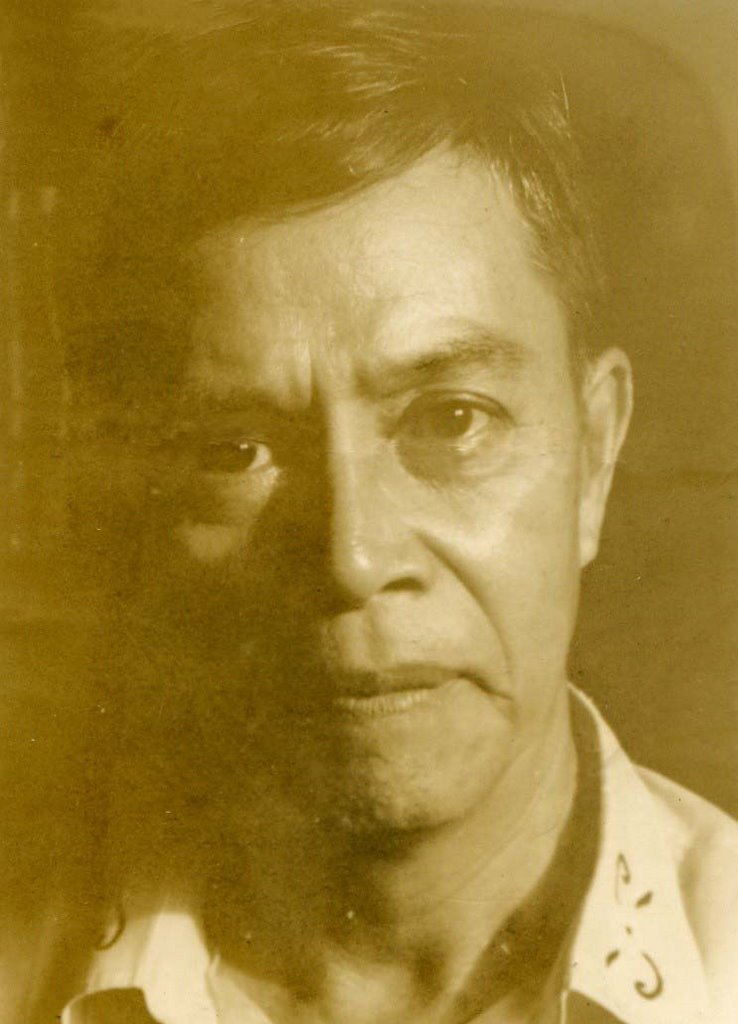 Stephen Cenon Dato Talla has published a blog in honor of his grandfather and poet laureate LUIS G. DATO. The blog contains the curriculum vitae of Chong Luis, his reflections on poetry writing, and several of his photos (one of which has been borrowed for this post). Click on the link below to visit Stephen's blog:
1/17/07
The Museum of Baaoeno Memory
The Museum of Baaoeno Memory sucessfully opened last December 29, 2006 amidst a strangely stormy weather. The room where it was located was earlier damaged by Reming and thus the museum opened with repairs unfinished and water from the bad weather dripping into the museum spoiled the otherwise significant and momentous occassion. There are plans to move the museum into a bigger place closer to the library. Calls have been made, specially by the SMA principal for donations of possible museum pieces in the form of household, farm implements, clothing articles, rare baaoenaina publications and photographs. The Museum is still currently improving its present set-up in time for the PAASCU visit as it is one of the best feature of the SMA library and a fine example of the Alumni collaborating with the school for the betterment of the local community. The Museum will also serve a s a venue for community extension as instruction aid to non-SMA students of Baao. The first activity of the museum slated for 2007 and sponsored by SMA batch 1983 is a workshop on finger painting for the SMA arts club members and other interested parties to be scheduled this February.
The Museum of Baaoeno Memory sucessfully opened last December 29, 2006 amidst a strangely stormy weather. The room where it was located was earlier damaged by Reming and thus the museum opened with repairs unfinished and water from the bad weather dripping into the museum spoiled the otherwise significant and momentous occassion. There are plans to move the museum into a bigger place closer to the library. Calls have been made, specially by the SMA principal for donations of possible museum pieces in the form of household, farm implements, clothing articles, rare baaoenaina publications and photographs. The Museum is still currently improving its present set-up in time for the PAASCU visit as it is one of the best feature of the SMA library and a fine example of the Alumni collaborating with the school for the betterment of the local community. The Museum will also serve a s a venue for community extension as instruction aid to non-SMA students of Baao. The first activity of the museum slated for 2007 and sponsored by SMA batch 1983 is a workshop on finger painting for the SMA arts club members and other interested parties to be scheduled this February.
11/29/06
Remembering Our Own Baaoeño Heroes
Baaoeño Heroes
Bonifacio Day brings our mind back to our heroes specially those we were made familiar with in school. Many Baaoeños though do not realize that our town has it lists of heroes too. Many among our compatriots are men who risked or sacrificed their lives in the pursuit of an ideal like liberty and freedom. Some of them simply exemplified greatness in their fields and taught others the capacity of the Filipino race. This is the heroism of Jorge Barlin when he broke the glass ceiling imposed by foreigners on our race. So too would Luis G. Dato do in his skill in the borrowed English language. Unlike Barlin and Dato though, more like Bonifacio, are Baaoeños who are heroes dying with clenched teeth and spilling blood in defiance of an enemy. I will not distinguish heroes from martyrs or victims because in the end, we will always remember their pointless death especially in war. My list of Baaoeño Heroes is still incomplete but it goes way back into history:
1. The ancient Baaoeño warriors who fought the Spanish in the 16th century (according to Fray Gaspar de San Agustin)
2. The Baaoeños led by the Mesia Brothers who fought neighboring Nabua in the Baao-Nabua boundary dispute in the 19th century.
3. Bishop Jorge I. Barlin
4. The Baaoeño Principalia who were arrested in suspicion of conspiracy in the Philippine Revolution.
5. The Baaoeño officers and soldiers under Gen. Ludovico Arejola who fought the Americans in the Battle of Agdangan and elsewhere.
6. Luis G. Dato, known in Philippine Literature as one of the earliest Romantic Filipino poet in English
7. The innocents of the Agdangan Massacre.
8. Eusebio Dato, Baao’s Chief of Police under the Japanese who was found clandestinely aiding the Guerillas. He was arrested, tried and executed at Colgante Bridge, Naga City. There was once a proposal in the City government to rename the bridge in his honor.
9. Dr. Dominador D.Uybarreta, young wartime doctor of Baao whose unselfishness to aid the sick and wounded earned him the suspicion of the Japanese. He was tortured and executed somewhere in Pili.
10. The soldiers from Baao and various guerilla outfits formed in Baao which would harass the Japanese during the war.
There will be other heroes and I will continue the list.
Bonifacio Day brings our mind back to our heroes specially those we were made familiar with in school. Many Baaoeños though do not realize that our town has it lists of heroes too. Many among our compatriots are men who risked or sacrificed their lives in the pursuit of an ideal like liberty and freedom. Some of them simply exemplified greatness in their fields and taught others the capacity of the Filipino race. This is the heroism of Jorge Barlin when he broke the glass ceiling imposed by foreigners on our race. So too would Luis G. Dato do in his skill in the borrowed English language. Unlike Barlin and Dato though, more like Bonifacio, are Baaoeños who are heroes dying with clenched teeth and spilling blood in defiance of an enemy. I will not distinguish heroes from martyrs or victims because in the end, we will always remember their pointless death especially in war. My list of Baaoeño Heroes is still incomplete but it goes way back into history:
1. The ancient Baaoeño warriors who fought the Spanish in the 16th century (according to Fray Gaspar de San Agustin)
2. The Baaoeños led by the Mesia Brothers who fought neighboring Nabua in the Baao-Nabua boundary dispute in the 19th century.
3. Bishop Jorge I. Barlin
4. The Baaoeño Principalia who were arrested in suspicion of conspiracy in the Philippine Revolution.
5. The Baaoeño officers and soldiers under Gen. Ludovico Arejola who fought the Americans in the Battle of Agdangan and elsewhere.
6. Luis G. Dato, known in Philippine Literature as one of the earliest Romantic Filipino poet in English
7. The innocents of the Agdangan Massacre.
8. Eusebio Dato, Baao’s Chief of Police under the Japanese who was found clandestinely aiding the Guerillas. He was arrested, tried and executed at Colgante Bridge, Naga City. There was once a proposal in the City government to rename the bridge in his honor.
9. Dr. Dominador D.Uybarreta, young wartime doctor of Baao whose unselfishness to aid the sick and wounded earned him the suspicion of the Japanese. He was tortured and executed somewhere in Pili.
10. The soldiers from Baao and various guerilla outfits formed in Baao which would harass the Japanese during the war.
There will be other heroes and I will continue the list.
10/22/06
10/20/06
In remembrance of the 62nd Anniversary of the Massacre of Agdangan
October 17th 1944
A dusty gray smoke
replaces the promise of
immaculate clouds of a new day
in the land scorched by the sun.
No one foresaw the fate of
doomed families, an end so grim
to stumble upon.
The sword unseeing, thrusts
and slashes with abandon
and lives cut down
like sheaves of grass and
left to prosper on fallow fields.
All to appease the vengeful,
bitter heart of the conqueror.
The old resigned to the falling
of the embers from the roof,
shield their wrinkled worn faces
with their bony arms,
and the young and the strong
let out suffering cries
and writhe in pain and wriggle
to be free of binding ropes as babies
are tossed to the bayonets
and the holocaust.
And a day passes to memory
from the infamy war
A dusty gray smoke
replaces the promise of
immaculate clouds of a new day
in the land scorched by the sun.
No one foresaw the fate of
doomed families, an end so grim
to stumble upon.
The sword unseeing, thrusts
and slashes with abandon
and lives cut down
like sheaves of grass and
left to prosper on fallow fields.
All to appease the vengeful,
bitter heart of the conqueror.
The old resigned to the falling
of the embers from the roof,
shield their wrinkled worn faces
with their bony arms,
and the young and the strong
let out suffering cries
and writhe in pain and wriggle
to be free of binding ropes as babies
are tossed to the bayonets
and the holocaust.
And a day passes to memory
from the infamy war
10/17/06
A Halloween Story in Baao
A Ghost of Fire
An Old Ghost Story set in Baao
Though we have no equivalent of a Halloween night in the Philippines, stories about fiery ghosts are heard in the town. With just a few details missing, we have a story like that of Washington Irving's "The Legend of Sleepy Hollow". These stories, I suspect arose from our proximity to a lake which would on occasion discharge the phenomenon we call in the vernacular as "santelmo". In Physics, "santelmo" or "St. Elmo's fire" is a ball of methane gas evaporating from a stagnant body of water like a marsh, lake or ricefield. Static electricity could set it aglow and the glowing ball would float eeriely on the surface of the water or ground were the wind would take it. I've heard of local farmers play with it by fanning it to make it move to any direction. To the unfamiliar, it would be a ghostly apparition, thus the stories we hear as children about ghosts that we might meet on the road at night. The following story was found published in a pre-war American magazine among a compilation of legends from the Philippines. The story was reprinted recently in the Philippines in a thick compilation of Philippine Legends. What other stories about Baao are hiding among the countless American publications about the Philippines I wonder.
Paulix Robosa
Once upon a time their lived in the town of Baao two robbers who were accustomed to attacking people who went past their hut, for in those days the government was weak. One day, a Tagalog merchant went to the robbers to sell them some clothes. The robbers offered the merchant good food and bed for his siesta. When they saw that he was sound asleep, they killed him and threw his body into the river. The night after the merchants death, people in the neighborhood heard a hoarse voice saying over and over again ”Give one half of my money to my family.” Chance travelers were terrified, for the spirit would whisper to them too. Finally the officials of the town asked the priest to exorcise the spirit. When he had performed the rites, the voice became silent. However at night a fiery man would walk about the town between the hours of seven in the evening to six in the morning. The inhabitants were so frightened that they ate their last meal of the day at Four o’clock, after which they shut up their houses tightly until the next morning. One time a traveler arrived in Baao about eight in the evening. As he passed the church, he saw the fiery man coming toward him. In terror he whipped up his horse and tried to get away, but the ghost caught hold of the reins and stopped the horse. The ghost turned into a real man and said, “Please tell the officials about the two robbers near the town. They killed a man secretly and took away his money.” Then the figure disappeared forever. In the morning the traveler hurried to the tribunal and told his story. The police captain sent five strong men to capture the robbers. Their guilt was proven and they were put into prison for a long time
10/8/06
8/27/06
A Story for the Feast of St. Bartholomew
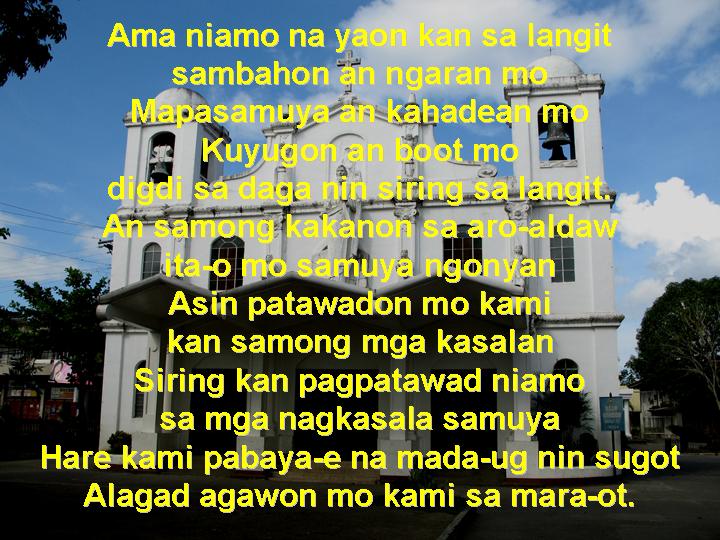
The Legend of the Lost Statue of St. Bartholomew
This is an old story about Baao’s patron saint, which I calculate, based on the generations that have heard it, to be more than a hundred years old. The story was told to me by an 80-year old neighbor who as a child, heard it from one of my great grandmothers who also narrates that she heard it from her own grandmother. In my childhood, I’ve heard parts of the story told to me by my parents. It’s been a while since I received a tip from a relative that in Nagcarlan, Laguna, there is indeed a statue of St. Bartholomew containing an inscription of “San Bartolome, Baao, Camarines”. I still do not have the time and resources to verify the truth on this. The following is the story as I heard it from my neighbor who has since passed away.
Paulix Robosa
There is a legend that has been preserved unto this day which is of small significance to our town. Whether this is true or not, I can only say one thing for sure, that nobody has ever exerted effort to prove it.
There was a time during the Spanish period when thunderstorms were very frequent. On one occasion, lightning struck the steeple of the town church which was then entirely built of wood and immediately caught fire. As the thunderstorm was at its worst, no one dared came out and come near the church. The small wooden church would be quickly consumed by the fire were it not for an astonishing but timely intervention by our Patron saint. It is said that as the fire raged, people could see, amidst the flames, our Patron Saint locked in battle with the fire. Soon as the fire subsided, it was found that the church was only partly burned and the statue of the saint only showed slight burns from the fire.
Despite the slight damage suffered by the church, the Parish Priest decided to build a new church in its stead. After completion of this new church it was also decided to replace the old singed statue of St. Bartholomew. So the day came when a perfectly new statue was placed in the altar, to everyone surprise the next day, this new statue showed the burnt marks found on the old image. An even bigger surprise came when the people found out that the old statue is nowhere to be found. The statue seemed to have disappeared angered it was thought, by being abandon by the people.
News later came that a statue of St. Bartholomew was found floating in waters somewhere in the Tagalog provinces and that the inhabitants who found it had difficulty pulling it out of the water because of its great weight. Now the statue they say can be found in one of the churches in one of the towns of this region.
Very few people now know of this story but this is very old and was told to generations within the town of Baao.
This is an old story about Baao’s patron saint, which I calculate, based on the generations that have heard it, to be more than a hundred years old. The story was told to me by an 80-year old neighbor who as a child, heard it from one of my great grandmothers who also narrates that she heard it from her own grandmother. In my childhood, I’ve heard parts of the story told to me by my parents. It’s been a while since I received a tip from a relative that in Nagcarlan, Laguna, there is indeed a statue of St. Bartholomew containing an inscription of “San Bartolome, Baao, Camarines”. I still do not have the time and resources to verify the truth on this. The following is the story as I heard it from my neighbor who has since passed away.
Paulix Robosa
There is a legend that has been preserved unto this day which is of small significance to our town. Whether this is true or not, I can only say one thing for sure, that nobody has ever exerted effort to prove it.
There was a time during the Spanish period when thunderstorms were very frequent. On one occasion, lightning struck the steeple of the town church which was then entirely built of wood and immediately caught fire. As the thunderstorm was at its worst, no one dared came out and come near the church. The small wooden church would be quickly consumed by the fire were it not for an astonishing but timely intervention by our Patron saint. It is said that as the fire raged, people could see, amidst the flames, our Patron Saint locked in battle with the fire. Soon as the fire subsided, it was found that the church was only partly burned and the statue of the saint only showed slight burns from the fire.
Despite the slight damage suffered by the church, the Parish Priest decided to build a new church in its stead. After completion of this new church it was also decided to replace the old singed statue of St. Bartholomew. So the day came when a perfectly new statue was placed in the altar, to everyone surprise the next day, this new statue showed the burnt marks found on the old image. An even bigger surprise came when the people found out that the old statue is nowhere to be found. The statue seemed to have disappeared angered it was thought, by being abandon by the people.
News later came that a statue of St. Bartholomew was found floating in waters somewhere in the Tagalog provinces and that the inhabitants who found it had difficulty pulling it out of the water because of its great weight. Now the statue they say can be found in one of the churches in one of the towns of this region.
Very few people now know of this story but this is very old and was told to generations within the town of Baao.
7/7/06
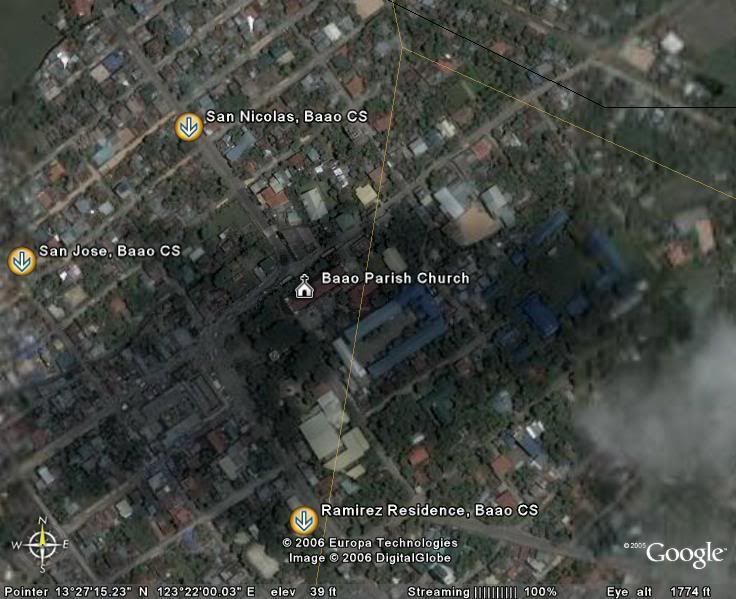
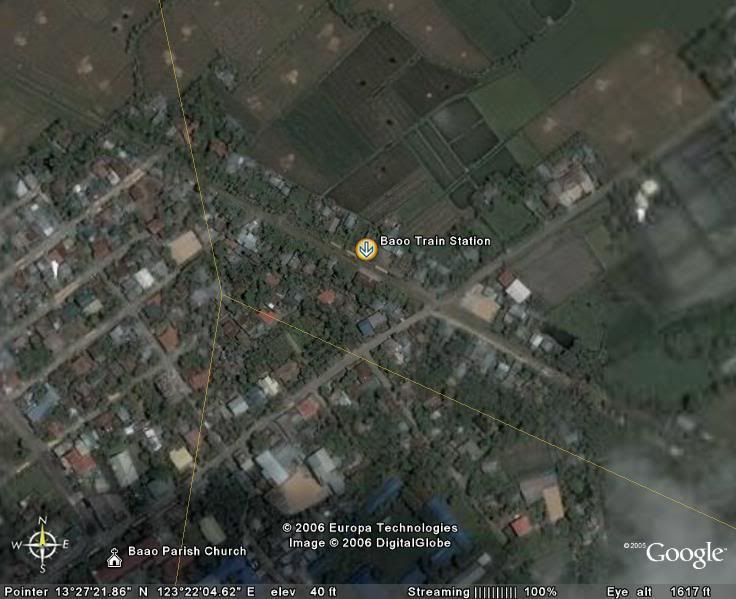
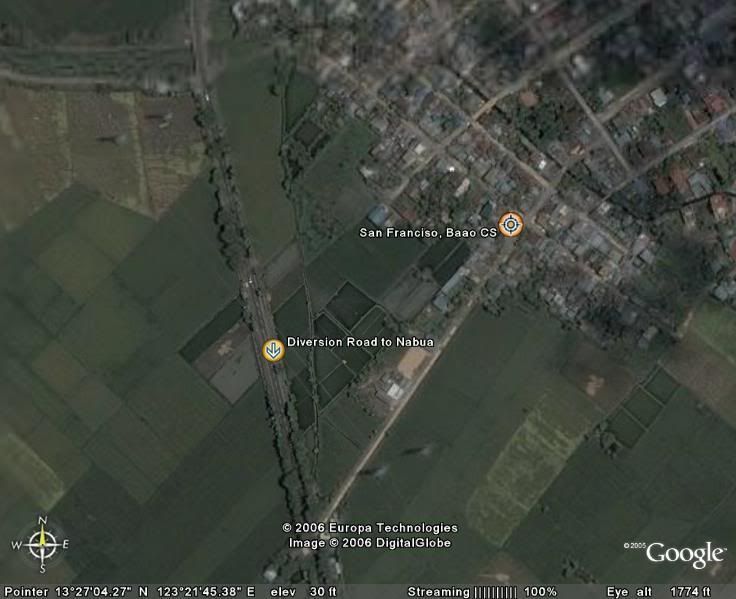
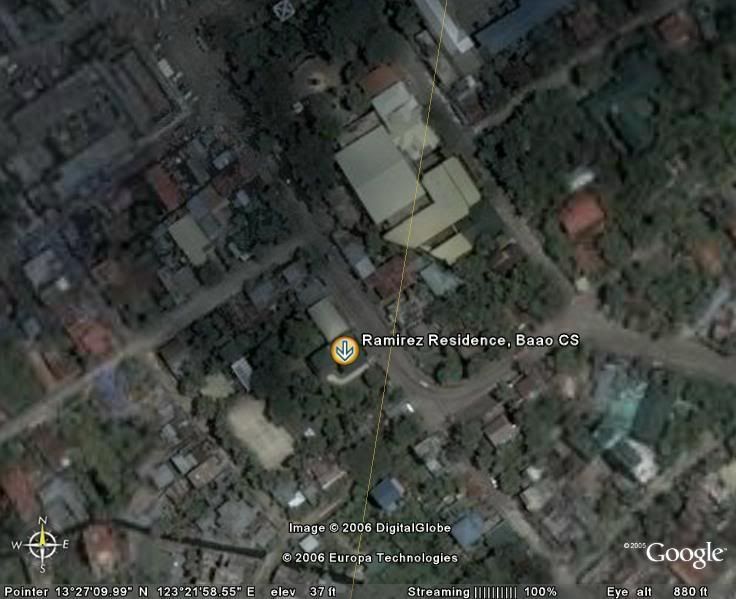
Satellite Images of Baao
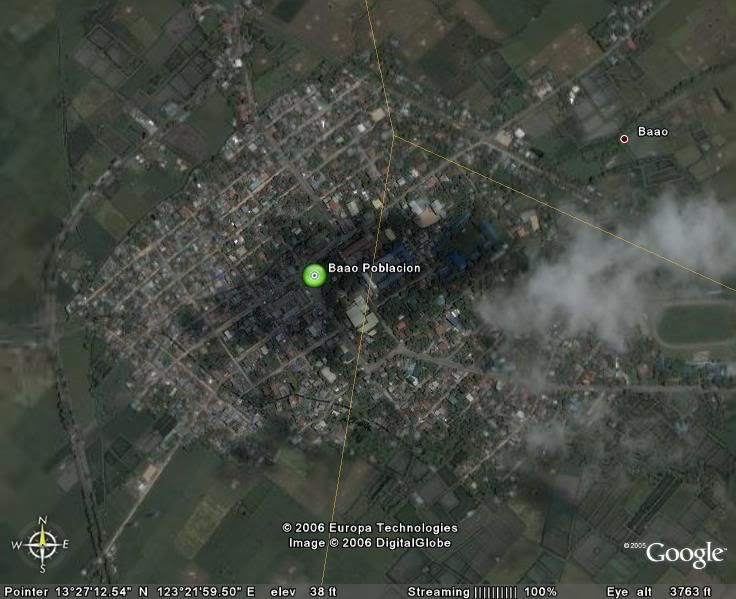
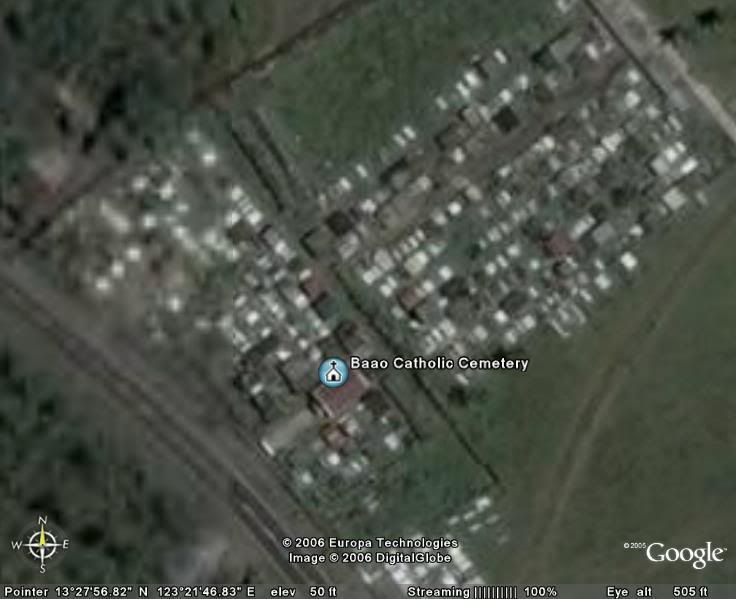
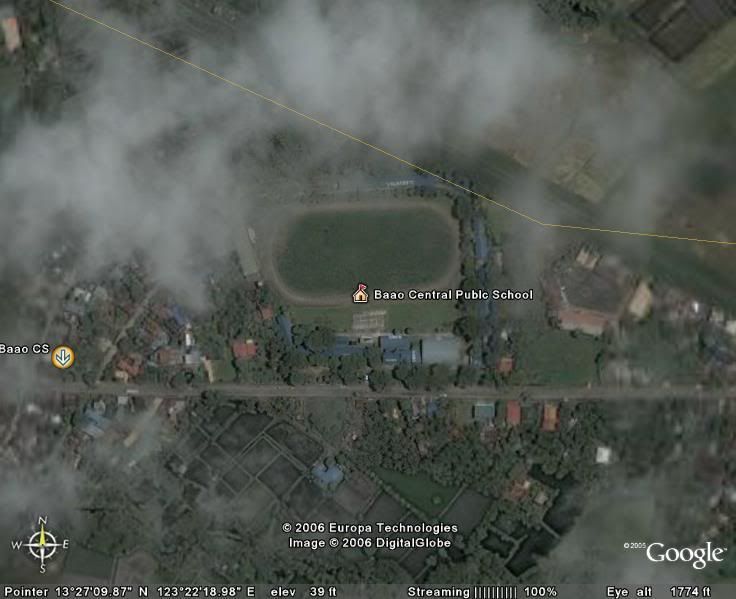
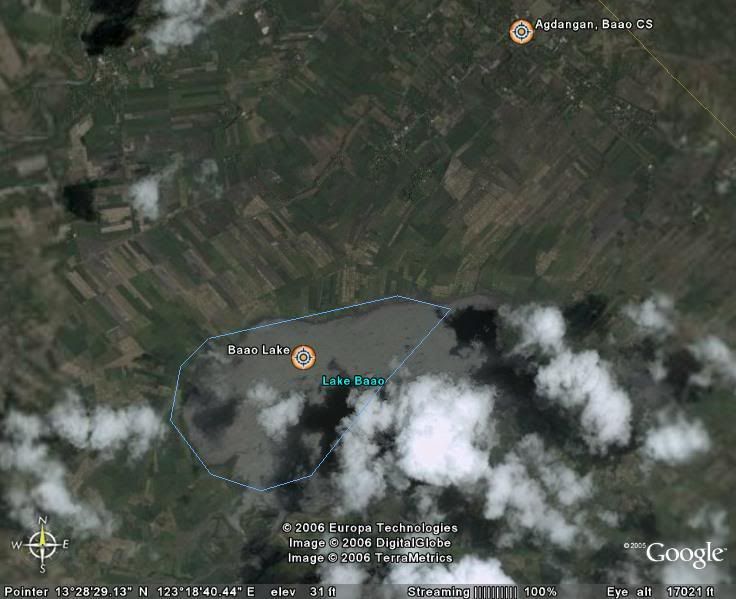
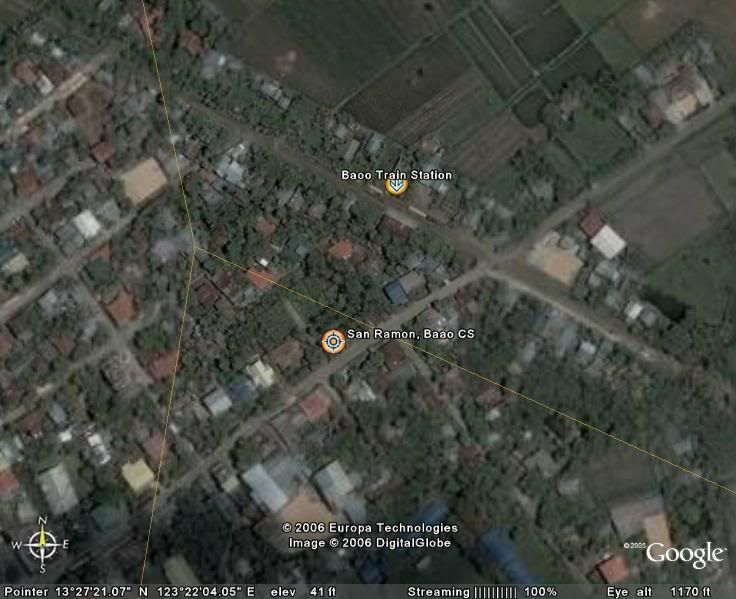
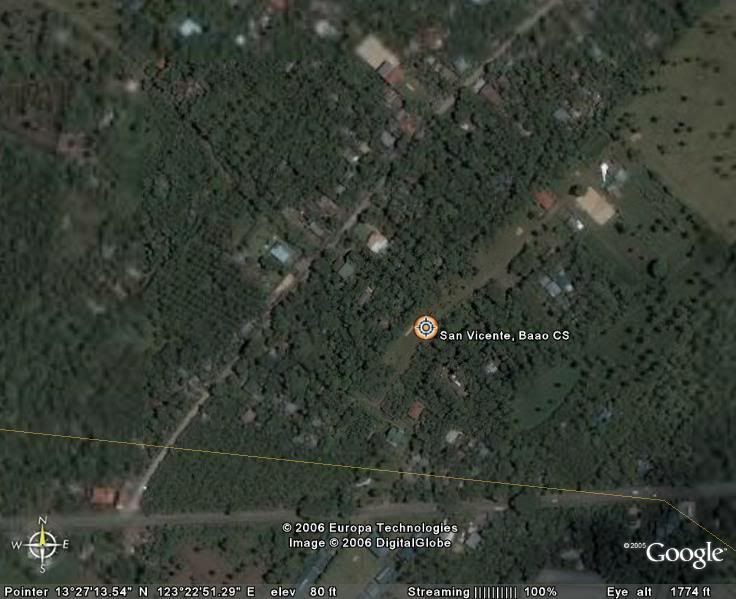
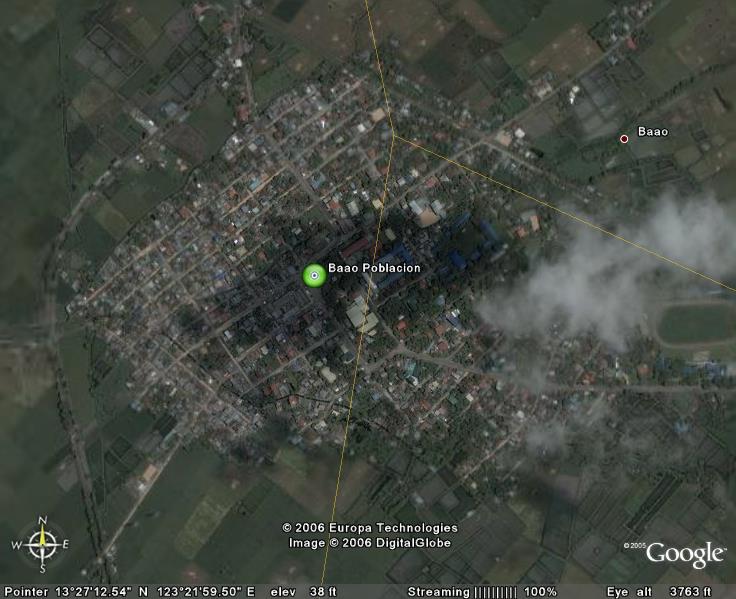 Here are various satellite images of Baao taken from Google Earth. Click on the links below: Riconada District * Baao Poblacion * Baao Catholic Cemetery * Baao Central Public School * Baao Lake * Baao Parish Church * Baao Public Market * Baao Train Station * Diversion Road * Ramirez Residence * Agdangan * Buluang * Del Rosario * La Medalla * Salvacion * San Francisco * San Isidro (Oras) * San Jose * San Juan * San Nicolas * San Ramon * San Vicente * Santa Cruz.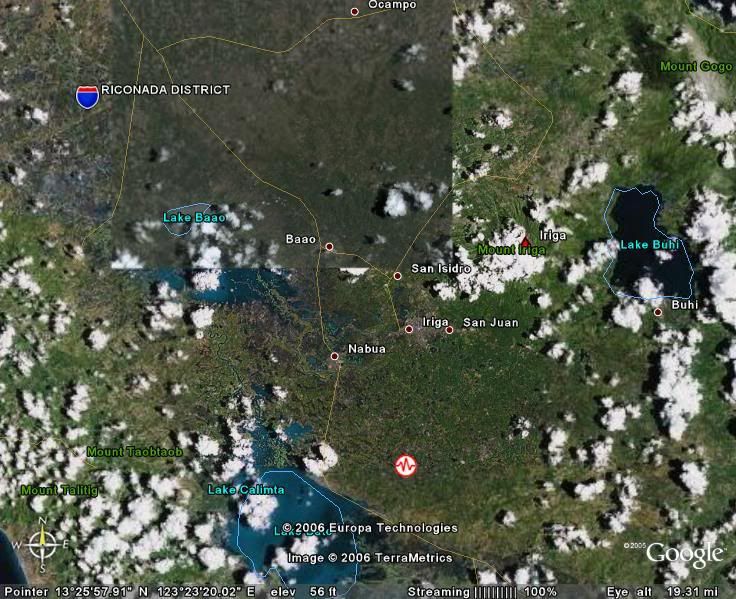

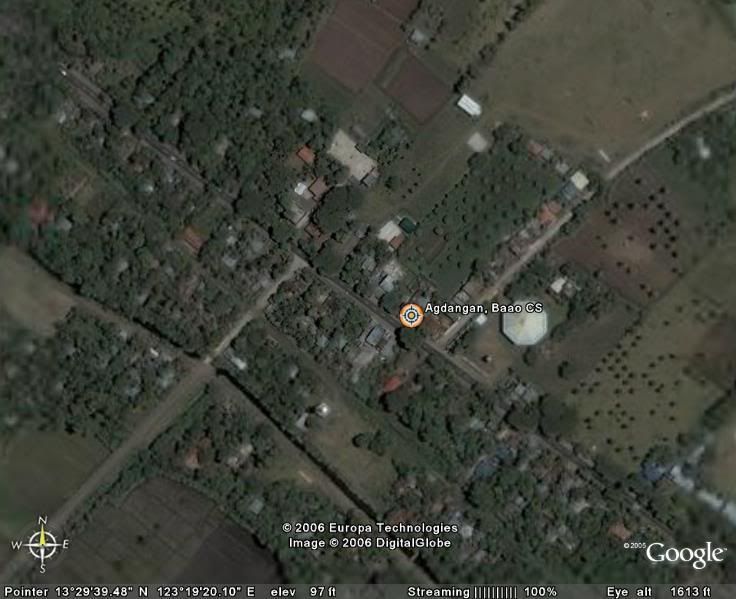
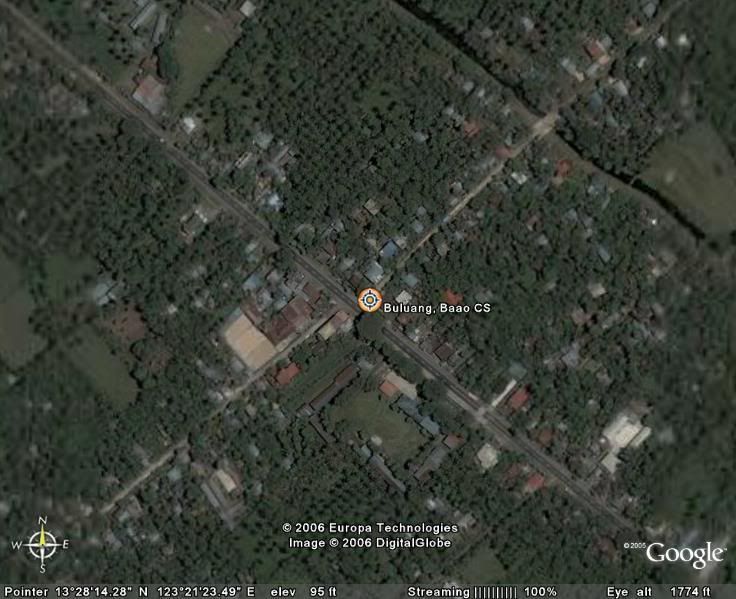
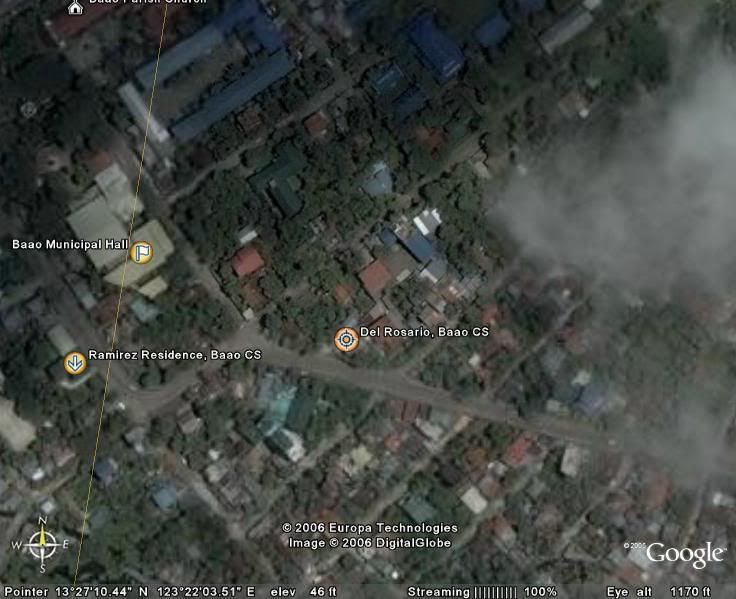
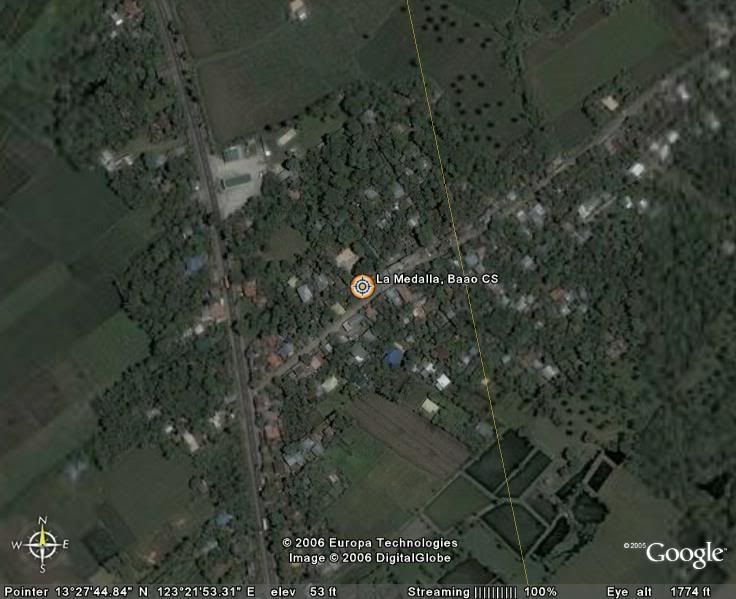
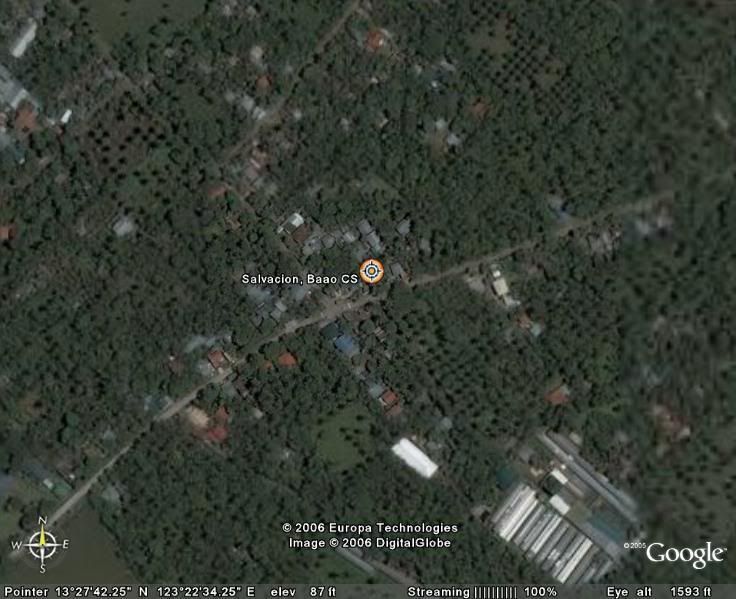
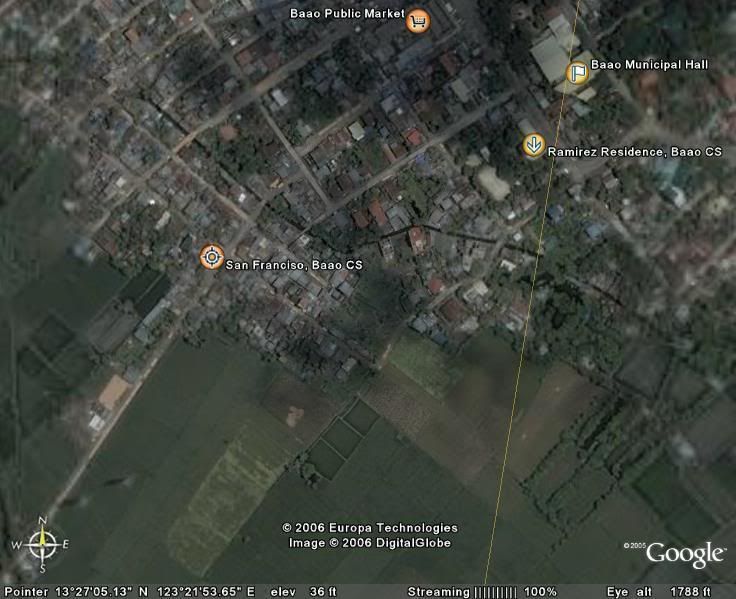
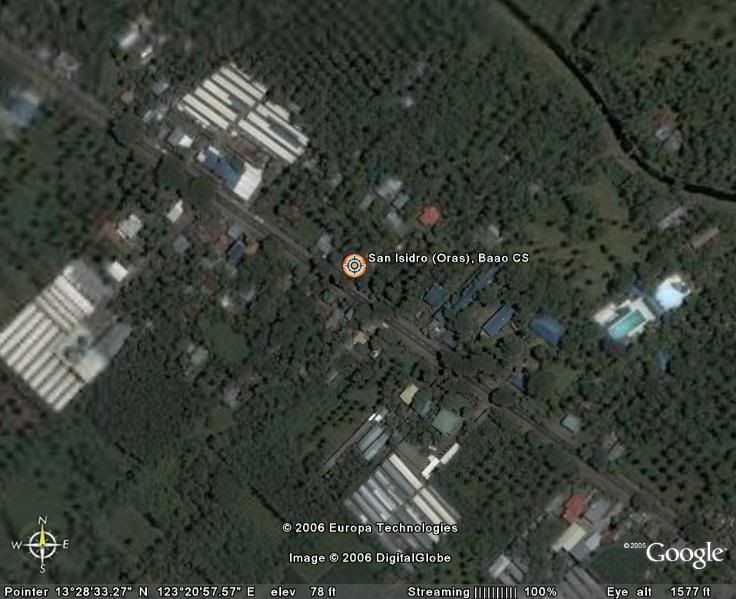


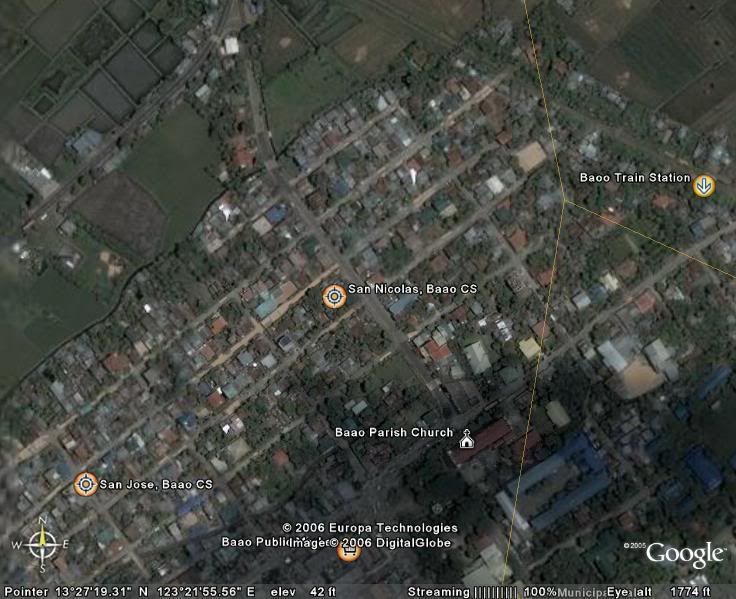

7/4/06
A poem for the Centennial Birth anniversary of Luis G. Dato
A Poem for My Home
I’m home in my own little patch of heaven,
a simple clump of cool peaceful green
encircled by blue horizons and air
interrupted by cream-colored concrete
toasted warm by the vibrant sun
and chilled in the pale orange evenings.
From its skies shower fragrant drizzle
that stir like the poems of Luis Dato,
or buffet like storm and lightning
worthy of the compatriots of intrepid Barlin.
Thus here, scattered among its days
are brave heroes and wise men born
By its lakeshores today as long ago
a determined people carves out a living
as they would a kingdom,
themselves prince and princesses
and lords and ladies with castles on the hill.
They would sit barefoot in the dewy summer grass
and watch at the end of day, their children, the slow,
steady flowering of their dreams.
Then shades of evening roll over
the oranges yellows and purples of a fading sunset
darker now under the waxing moon,
at the moment in shadows never alone,
in this little heaven we have known.
7/1/06
The Uglification of the Town Plaza
 The rapid development of Baao has brought about contrasting results (see Images of Baao). On the one hand, some historical sites have been renovated (e.g., the
 The town plaza used to be a spacious green park in the middle of the town. But now the area has been considerably reduced by new structures built there by the municipal authorities. The result is congestion. Moreover, some parts of the park have become a junkyard for cars and machines, etc. Food stalls have been allowed to squat on the public domain.
Before, at any vantage point in town one can see the beautiful mountain ranges of Caranday and the lofty
Baao sorely needs of a town planner who will take into consideration the environmental needs of the community… someone who can keep the town GREEN and CLEAN.
6/22/06
A poem by P.B. Robosa
Grandpa and the Gabi
Grandpa cooks and eats every
part of the gabi,
savors each kind in any cooking,
consuming the roots, the stems
up to the best part,
the large waterproof leaves.
I even saw him enjoying
the fragrance of the gabi flowers.
He patiently rolls the young leaves
into cylinders and ties them
with the stem and before the rice cooks,
steams them over its surface,
later adding shrimp paste and masticating
each singularity of the plant
with his fingers
down to its very core.
I, his grandson laughs
at his innocent, frugal folly.
Stems and discarded leaves cover my plate--
I doubt the parts are edible.
I, his grandson was not yet old enough
to eat like a goat.
I will grow up in a world
tired of nibbling at the leaves
and fears the bite of the acid beneath
and throws the plant away.
Maybe I will be one to retrieve
the rejected plant from the garden,
patiently tear the leaves to small pieces,
and discover its distinct forgotten taste.
Grandpa cooks and eats every
part of the gabi,
savors each kind in any cooking,
consuming the roots, the stems
up to the best part,
the large waterproof leaves.
I even saw him enjoying
the fragrance of the gabi flowers.
He patiently rolls the young leaves
into cylinders and ties them
with the stem and before the rice cooks,
steams them over its surface,
later adding shrimp paste and masticating
each singularity of the plant
with his fingers
down to its very core.
I, his grandson laughs
at his innocent, frugal folly.
Stems and discarded leaves cover my plate--
I doubt the parts are edible.
I, his grandson was not yet old enough
to eat like a goat.
I will grow up in a world
tired of nibbling at the leaves
and fears the bite of the acid beneath
and throws the plant away.
Maybe I will be one to retrieve
the rejected plant from the garden,
patiently tear the leaves to small pieces,
and discover its distinct forgotten taste.
5/15/06
A poem by P.B. Robosa
Keeping Time
My grandmother never had much,
slender frame and thin gray hair
sang old lullabies and danced
through afternoon siestas
and wiled away time playing cards.
I still remember her calloused fingers
as she puffed on the senorita
toward her chest and out again,
watching time’s rhythm
with the melodies from the old radio
and fresh wind from the window.
I remember how she used to put pillows
on her lap for my afternoon naps.
Nothing felt better than drifting
to sleep wrapped in one of grandma's hands,
listening to her cracked, aged voice
singing, "sleep, oh, baby."
So warm, I thought I would never feel cold
again.
My grandmother never had much,
slender frame and thin gray hair
sang old lullabies and danced
through afternoon siestas
and wiled away time playing cards.
I still remember her calloused fingers
as she puffed on the senorita
toward her chest and out again,
watching time’s rhythm
with the melodies from the old radio
and fresh wind from the window.
I remember how she used to put pillows
on her lap for my afternoon naps.
Nothing felt better than drifting
to sleep wrapped in one of grandma's hands,
listening to her cracked, aged voice
singing, "sleep, oh, baby."
So warm, I thought I would never feel cold
again.
4/18/06
Holy Week 2006 Photo Albums
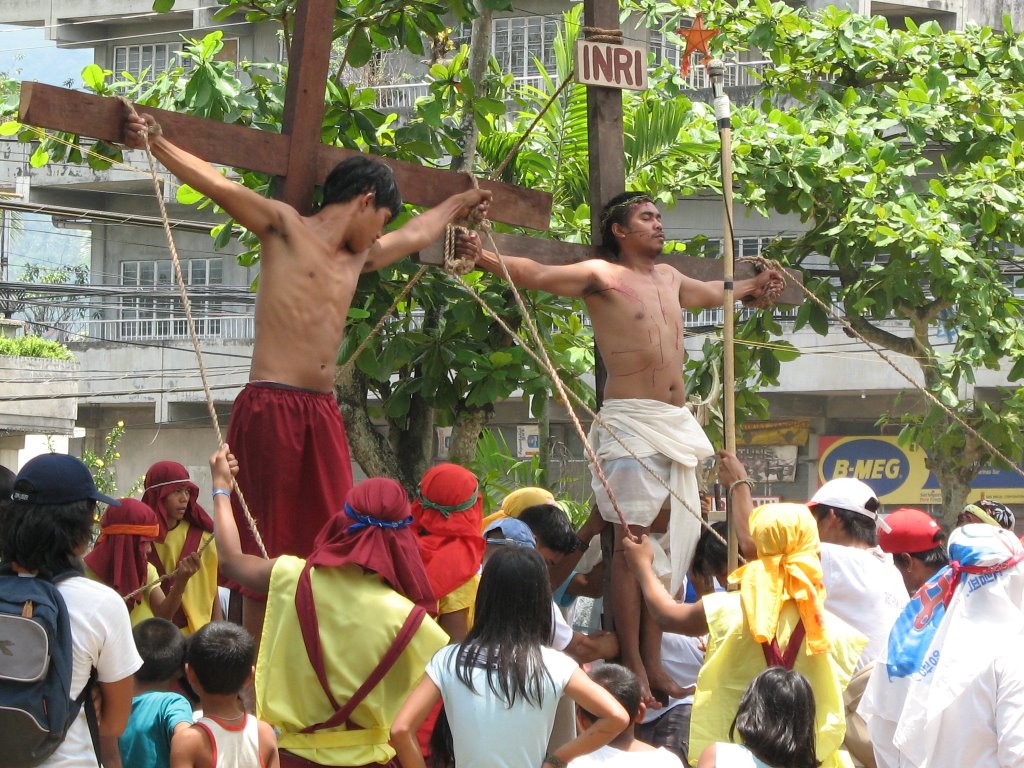 Cenaculo staged at the church patio last 12 April 2006 (Wednesday). Click on the following links for more photos of the Holy Week 2006 taken by Felipe Fruto Ll. Ramirez, SJ:
[1] Domingo de Ramos; [2] Miercules Santo; [3] Viernes Santo; [4] Soledad; [5] Domingo de Pascua; [6] Images of Baao; [7] Medical Mission
4/16/06
Requiem for the Dead at the Battle of Agdangan
In memory I was a fool deceived by
flighty passions and arrogant dreams.
Running with charlatans in uniforms
reveling in brave talk of revolution.
So marched I to the clangor of battle
death calls dressed in bold adventure
The sun must rise in the east, they say,
bring a fiery sunrise to this doomed land
where flowers never bloom and flourish
on infertile fields undisturbed by graves,
mourned and unlamented by our tears.
Water and till it with blood to let it live?
Content then I was already of my rest,
glad of my lot and place seeking only
that the land enfold me with abundance
as I pay it my love and constant labor
following the ways of my ancestors
in this land of kindness and beauty.
Fate inevitably revealed trumpet calls
from ominous clouds from the west
threatening to lay waste my fields
where my hand had lovingly borne
seeds from my table and flowers bloom
on land once laid bare and unsown.
Banners bloodied beneath Simurai
at the stairway to clouds we battened
against the intruder overwhelming
with pen, paper, bullets and Krags.
I stood with teeth and fist and fought,
‘until shot and blades our belly opened
Is there not valor in simply to love?
To clasp and embrace what is dear.
Isn’t courage a fight for lost causes?
for treasured but long lost freedoms,
for struggles to grow strong and better
for that end-greatness was our quest.
To see in my land, my children beloved
warmed soft by gold, glowing sunbeams,
running free in the fields of the fallen
over grass blown by unfettered wind,
on earth held not by might and power,
but by those who loved and tilled her.
Memory die away lost to the grave,
words, deeds finally pass and fade
So, stranger by the road, recall then
that day that I lost all, but saw at last
my sunrise, my grass green and warm
as I fell at the Battle of Agdangan.
P.B. Robosa
flighty passions and arrogant dreams.
Running with charlatans in uniforms
reveling in brave talk of revolution.
So marched I to the clangor of battle
death calls dressed in bold adventure
The sun must rise in the east, they say,
bring a fiery sunrise to this doomed land
where flowers never bloom and flourish
on infertile fields undisturbed by graves,
mourned and unlamented by our tears.
Water and till it with blood to let it live?
Content then I was already of my rest,
glad of my lot and place seeking only
that the land enfold me with abundance
as I pay it my love and constant labor
following the ways of my ancestors
in this land of kindness and beauty.
Fate inevitably revealed trumpet calls
from ominous clouds from the west
threatening to lay waste my fields
where my hand had lovingly borne
seeds from my table and flowers bloom
on land once laid bare and unsown.
Banners bloodied beneath Simurai
at the stairway to clouds we battened
against the intruder overwhelming
with pen, paper, bullets and Krags.
I stood with teeth and fist and fought,
‘until shot and blades our belly opened
Is there not valor in simply to love?
To clasp and embrace what is dear.
Isn’t courage a fight for lost causes?
for treasured but long lost freedoms,
for struggles to grow strong and better
for that end-greatness was our quest.
To see in my land, my children beloved
warmed soft by gold, glowing sunbeams,
running free in the fields of the fallen
over grass blown by unfettered wind,
on earth held not by might and power,
but by those who loved and tilled her.
Memory die away lost to the grave,
words, deeds finally pass and fade
So, stranger by the road, recall then
that day that I lost all, but saw at last
my sunrise, my grass green and warm
as I fell at the Battle of Agdangan.
P.B. Robosa
4/7/06
The Museum of Baaoeño Memory
Name and Address
The Museum will be called "Museum of Baaoeño Memory/Museo ng Pang-alalang Baaoeño/Museo kan Pangiromdom Baaoeño/ Museo kin Pangrorom Taga Baao. It is located at the Second Floor of the Coop Building of St. Monica Academy, Baao, Camarines Sur.
Organizational Structure
The museum will be a joint project of the St. Monica Academy and the SMA Alumni Association with a continuity clause that it will be maintained by the Spirit of 78/82 with Mr. Paulix Robosa as its Curator even if the batch is no longer the SMAAA host. SMA shall provide the site of the museum and The Spirit of 78/82 through Mr. Paulix Robosa as volunteer curator will undertake the duties of such position for the proper operation and maintenance of the same. The curator will organize appropriate activities for the promotion of Baaoeño arts and culture and will link with appropriate government agencies for grants and other sources of funds.
Museum Objectives
1. The collection and exhibition of Baaoeñana materials and artifacts i.e photographs, historical and cultural documents, literature, visual art works.
2. The promotion of Baaoeño arts and culture through occasional exhibits featuring museum collection and Baaoeño artists and artworks.
3. The acquisition of archival materials regarding Baao and its people from sources all over the Philippines and the world, and to make them available to students and researchers.
Tentative Dates of Opening
June 29,2006/August 23, 2006/ December 8, 2006
4/5/06
Another Poem by Luis G. Dato
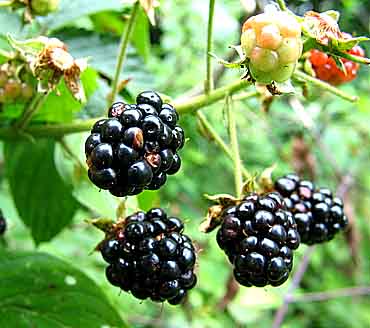 Day In the Farm
by Luis G. Dato
I’ve found you fruits of sweetest taste and found you
Bunches of duhat growing by the hill,
I’ve bound your arms and hair with vine and bound you
With rare wild flowers but you are crying still.
I’ve brought you all the forest ferns and brought you
Wrapped in green leaves cicadas singing sweet,
I’ve caught you in my arms an hour and taught you
Love’s secret where the mountain spirits meet.
Your smiles have died and there is no replying
To all endearments and my gifts are vain;
Come with me, love, you are too old for crying,
The church bells ring and I hear drops of rain.
Subscribe to:
Posts (Atom)