During the Holy Week services in Baao, especially during the Holy Thursday liturgy reenacting the "Washing of the Apostles' Feet", the roles of the twelve apostles are played by several reputable men of Baao who are traditionally chosen for their good moral character, if not for their closeness to the Parish Priest. Unless one resigns or is incapacitated, the 'office' of an apostle is held for life.
Click for more pictures: Group: 1, 2, 3, 4. Individuals: 1, 2, 3, 4, 5, 6, 7, 8, 9, 10, 11.
The society has been established to promote research on the history and culture of the town of Baao, Camarines Sur, so as to preserve its rich historical and cultural heritage, and to cherish the memory and legacy of its illustrious people.
5/5/08
Apostles of Baao
3/13/08
Sifting
Through Perceptions: A Fresh Look at Baao's Beginnings
An
excerpt from "Baao Vignettes" by P.B.Robosa
Authors’s
note: So that a new Municipal official seal could be submitted to the National
Government, it became a matter for the local government to establish and
clarify once and for all the town’s foundation date .I was one of those invited
to provide some explanation to the question and in the process finally
appreciated the extent or lack thereof of our knowledge of our past. In looking
at our past, we are provided an opportunity to appraise our origins and along
the way look into ourselves. Having done so, we can understand our actions and
reactions to the changes and struggles we continue to face.
In
the early months of 1889, Lt. Jose Taviel de Andrade of the Civil Guards went
on inspection tour of the towns of Southern Luzon. A talented artist, his
inspections produced illustrations of the towns he visited and one among these
was that of the town center of 19th century Baao. His illustrations from Baao
bore three vignettes; a squatting man with a child, a bell tower and a scene of
the town “poblacion” showing a cross at the center of a group of palisaded
houses.
A
modern commentary of this illustration presumes that the cross was intended to
commemorate the town's still unverified founding by St. Peter Baptist in the
twilight of the 16th century. Carefully read, the commentary echoes the opening
passages on the work on the history of Baao by the Franciscan scholar Fr. Felix
de Huertas who implies that the circumstances regarding the foundation of the
town is unconfirmed. This statement has gained much acceptance with writers but
is in direct contradiction to the Catholic Church’s pronouncement that the
Franciscan saint did indeed found the town in 1590.
Although,
to modern historians, the town’s foundation date marks only the start of the
town’s recorded history, the 1590 foundation date is, nevertheless, significant
as the formation of the town as a religious and political unit during the
Spanish regime. Be that as it may, between Huertas and the Catholic Church,
whom do we believe? Is their a way to verify which of these claims is correct?
Published
in 1865 and widely available, Huertas’ Estado Geografico, Topografico,
Estandistico, Historico-Religioso de la Provincia de San Gregorio Magno, has
become a popular reference source for the historical records of Philippine
towns. Aside from being based on the Franciscan records Huertas had available
to him, his concise chronological presentation of his data makes his book a
handy source especially for amateur historians.
Baao’s
own Luis Dato in his attempt to provide clarification to the unrecorded origin
of Baao readily quotes Huertas even as he pointed out that Huertas’ claims
contradict data by that of another Franciscan author, Eusebio Gomez-Platero.
While Huertas cites the tradition that Baao was founded in the time of Peter
Baptist, he discards this information and puts forward a latter date that agrees
with his records and his strict definition of a “foundation”. Because of
Gomez-Platero’s biographies on Franciscan priests serving in Bicol towns, we
are lead to doubt Huertas’ records when the village had priests administering
to it years before the village Huertas’ claims became an independent religious
unit. Thus later, Dato unable to be sure of Huertas’ and Gomez- Platero’s
claims left the question of the town's origins to “the assiduity of future
local historians.”
Up
until recently, except for the Catholic Church's uncompromising statement on
the foundation of Baao as recorded in their directory, there was no
authoritative source available to be found of the “foundation” of the town. In
Dato’s time, this lack of definitive source led him to write in resignation
that Baao’s origins “are shrouded in myths and legends”. Although his statement
holds true when we speak of pre-Hispanic Baao, other documents that have come
to light today if that if we are to speak of the formation of the town at the
time of Spanish conquest, this statement quite mistaken and needs correction.
What
are then the available data, at present, of the origins of the town? Except for
Huertas’ difficulty in agreeing with the established assertion of the Church,
there is really no significant opposition to the 1590 date. The problems
Huertas encounter are due to two reasons: First, although the tradition of St.
Peter Baptist's founding Baao is firmly established by his sources, the
documents to which he decides to give credence rather than tradition, mentions
Baao only in 1656, sixty-six years later than the traditional date of 1590.
Second, he is honest about his uncertainty of the meaning of the term
“foundation” as to whether this happened during the conversion of the people
or, during the time the town formed its own civil or religious unit.
Because
of existing documents that were once unavailable to him, we may now be able to
smooth out some of his difficulties. Regarding documents mentioning Baao at the
earliest time, Huertas’ sources are antedated by documents found in Blair and
Robertson's The Philippine Islands, 1493-1898. The books reprints the original
and translations of the documents "The Status of Encomiendas, 1591"
and Bao or Baao was already mentioned as an encomienda with more 700
inhabitants a year after the 1590 traditional foundation. This invalidates by
66 years Huertas’ claim the town was first mentioned in documents.
Regarding
Huertas’ qualification for the foundation of the town as to whether foundation
was to mean during the conversion of the inhabitants or, by Baao’s formation
into a separate religious and political unit, the following excerpt below
appears to give us the answer:
King
- His majesty has another encomienda also) Nabua by name, numbering one
thousand and eighteen whole tributes, or four thousand and seventy-two persons.
The villages of this encomienda are near together. They used to have four
ministers, for they visit the two following encomiendas. There are in Nabua two
Franciscan friars.
Bula:
Dona Maria de Ron - The village of Bula belongs to Dña. Maria de Ron. It is
four leagues from Nabua. It has two hundred and six whole tributes, or eight
hundred and twenty four persons. It is visited from Nabua.
Bao:
Minor son of Sebastian Perez - These fathers of Nabua visit also the encomienda
of the minor son of the late Sebastian Perez, called Bao. It has one hundred
and seventy tributes, or seven hundred and four persons. Like Nabua, the
capital, it used to have four friars, but now has not more than two. These
encomiendas are not well administered but five religious would be sufficient
for it.
Buy:
Sebastian Garcia - likewise these fathers of Nabua visited and instructed the
encomienda of Buy, which belongs to Sebastian Garcia; but they can do so no
longer. It is two leagues from Nabua, and can receive instruction from no other
place. It has three hundred and twelve tributes, or one thousand two hundred
and forty-eight persons, who will receive instruction, when Nabua the capital,
has the said five ministers.’
The
document, aside from negating Huertas’ sources, also render somewhat erroneous
the statement that Baao's "conversion" cannot be considered as a
“foundation”. How can the conversion of the people and village of Bao qualify
as the time of foundation of Baao? Using even Huertas’ own criteria, a
convincing argument can be made to reconcile both events.
An
“encomienda” in the beginning of the Spanish conquest of the Philippines is a
royal charge to a person (in Baao’s case a Spaniard named Sebastian Perez) to
collect tributes from the inhabitants of a village. In exchange, the
“encomendero” must provide protection, justice and instruction to the faith
while he and his heirs maintain the encomienda. Thus, if Baao was converted and
was an encomienda in 1590, a rudimentary civil and religious unit was formed
with the intent to provide order, justice, instruction including catechism and
rites of the Catholic faith. This would sufficiently satisfy Huertas’ own
definition of a “foundation”, the formation of a political and religious unit
under the Spanish crown.
The
above passages in addition, by supporting Baao's foundation in 1590, also
overturn what we now know as misconceptions of Baao's origins. For instance,
because of Dato’s use of parts of Huertas in his frequently reprinted “Brief
History of Baao”, when he commences with Baao as a “visita” of Bula, Baaoeños
in general assume that Baao was originally a part of Bula like a modern barrio
connected to a “Bula poblacion”. If we follow this line of thinking but pushing
back time 66 years before, Baao, Bula and Buhi, were originally once “Barrios”
of Nabua.
The
Spanish dictionary defines "visita" as a religious term referring to
a village with a chapel where services where periodically performed by a
visiting priest. The priest so assigned makes scheduled visits to the place
because of the difficulty posed due to the lack of roads and conveyance between
these inland villages. Unlike modern “Barrios” which are originally “Sitios”
which are found within the boundaries of and later to be carved out from
existing municipalities, Nabua, Bula, Bao, and Buy were all originally separate
encomiendas with no clear boundaries and separated by great distances.
Politically,
since there was no defined boundaries of the encomiendas or visita, being a
visita would not mean affiliation or continuity with another, as do modern
barrios to town centers but affiliated simply religiously, by being
"visited" from one place due perhaps to proximity or convenience. Let
us repeat this line from the Account of Encomiendas to clarify this
arrangement: “likewise these fathers of Nabua visited and instructed the
encomienda of Buy, which belongs to Sebastian Garcia; but they can do so no
longer. It is two leagues from Nabua, and can receive instruction from no other
place.”
Thus,
being an encomienda, Buhi like Baao, from the beginning was not part of any
place but was an independent village on its own. Also from this example, it
appears that the “visita” stage was simply part of a process that each village
might undergo or might lose depending on the conditions and availability of
clergy that would be able to administer to the village. Take the cases of Buhi
and Bula; Buhi a decade earlier was administered from Nabua but in 1591 was
not, Baao became independent of Nabua when it became a “visita” of Bula even if
the latter was still also a visita of Nabua. It was not 100 years later that
Bula became independent of Nabua.
But
what is most remarkable when we study these passages is that it gives us a hint
to what it was like during Baao's conversion. Note that while the other
encomiendas in the list were being "visited" by friars from Nabua,
Bao is mentioned, to have recently had its own friars. We know from records
that Nabua,. Bula and Buhi were founded a decade or more earlier than Baao and
should have reached a degree of stability at this time, Baao was reportedly not
visited by friars but "used to have four but now has no more than
two". What happened in Baao prior to 1591 that required the services of four
friars and still required two a year later? Was the 1591 account simply
reporting the aftermath of a mass conversion of the people of Baao in 1590?
It
is likely that Baao as a separate civil or religious unit may have regressed or
was neglected in the years following its conversion like Buhi in 1591 though
converted 20 years before. These lapses may have accounted for the loss of
records of the town in Huertas' sources. The 1591 document is a clear picture
of the formation of Baao, a year after its conversion and a record of the
establishment of Spanish government and religion. From that point, Baao entered
the gates of recorded history and the Baaoeños ceased practicing their native
culture and religion.
How
true then is the tradition that Baao was founded by Saint Peter Baptist?
Huertas mentions the tradition that “the town was founded in the time of our
Holy Custodian Fr. Pedro Bautista" which covered the period in 1590 to
1591 when St. Peter Baptist was elected custodian of the Franciscan Missionaries
in the Philippines. Beloved by the Franciscans, St. Peter Baptist is the
subject of many stories and legends. But according the Saint’s biographers
(Gomez-Platero's Catalogo Biografico and Sta. Inez's Cronicas) in 1590 he
traveled to the Bicol region and founded several villages with Bao among them.
He stayed in the region until 1591 when he returned to Manila to assume
guardianship of the Manila convent. He finally sailed for Japan in 1593 as
envoy to the court of Taicosama, dying there later in 1597 as a martyr.
None
of his biographers though, specifically mentions details of him founding Baao
and most were writing many years later after the supposed event. It is
important to note though that all the same, his biographers agree to the dates
regarding his travels particularly the years 1590 and 1591 when he was in
Bicol. Accordingly, it would indeed be plausible that he passed by Baao or if
he did not, caused his brother Franciscans to convert the Baaoeños in 1590. If
these events are true as the Church believes and claims them to be, indeed St.
Peter Baptist had a hand in the conversion of the Baaoeños and in so doing
founded the present day Municipality of Baao which today accepts 1590 as its
foundation year.
We
might not know for sure if the Cross that was in the center of Baao in 1889 did
indeed honor St. Peter Baptist, but he was much endeared to his brother
Franciscans, it would be uncharacteristic for them to let the opportunity slip
for creating another legend for a great man.
Baao
and Ockhams’s Razor
by
P.B.Robosa
While
in discussion with two of my colleagues at USI, one teaching Philosophy and the
other History, the latter brought up the subject of place-names and said that
almost all places now seem to have a local legend as to how a place-name came
to be and added this was the fault of the Americans who taught us to read and
write about this stories. Incredulously I checked my files and but found this
not true as my Spanish sources also contain explanations of the origin of place
names but comparing the Baao history of Luis Dato with that of the Spanish
historian Felix Huertas which are two popular sources, I found something
interesting about the two. While Dato actually used Huertas as his source, it
was only he who wrote about of the possible origins of the name Baao giving us
three theories the first two being widely accepted:
1. Baao comes from the shape of the early settlement which was shaped like the
backside/carapace of the turtle which in local vernacular referred to as a
"ba-oo".
2. The name Baao came directly from the aforementioned reptile which in large
numbers inhabits the lake.
3. The name came about due to the penchant of the inhabitants of eating left
over rice locally called "bahaw".
Huertas, however, writing much earlier using Franciscan records mentions none
of these, although he does so with other places. In Huertas’ 1855 Estado, the
pertinent line referring to the origin of the town reads, “Antiguamente, estuvo
situado a la orilla de la laguna del mismo nombre, en el sitio llamado layoan.”.
Translated it reads: In ancient times, (the pueblo of Baao) was situated in the
banks of the lake of the same name, in the site called layoan.
This puts forward some questions like, which came first, the name of the lake or the name of the settlement? Did the name Baao came from the name of the Lake Baao or vice versa.
Which is connected with theory number two, did the lake or consequently Baao
came from
an alleged preponderance of turtles in the area?
A
year ago, I went to see these places mentioned by Huertas, The Lake would
really be shallow to be able to see layoan otherwise the place would be
under water and indeed the banks would accommodate an ancient settlement that
would have been widely spread out to give room for living space. About two
kilometer south is sitio Mawacag, the ancient burial site that yielded a
cache of Chinese porcelain giving proof to the site as a pre-hispanic
settlement. If the Lake was named after the turtle, the reptile is now
difficult to find now largely replaced by field rats. The ancient binanuaan site
a circular mound overgrown with brush and bamboo is east of layoan and
would be too small to contain a village but most likely the site of a town
center, a chapel or a market place, but again the lake would really be shallow
for the mound to be of any use for human activity but from afar would look like
the backside of a turtle just like any island would look in flat water. I
understood why the village kept moving east up to the present site, if Layoan
was inundated, binanuaanan was not, if binanuaanan was flooded
the present site was not and I understood how Dato could make sense of all of
these and came up with a believable theory. Then my friend, the Philosophy
teacher introduced me to William of Ockham and his scientific precept called
Ockham’s razor. Ockham’s razor is a fundamental principle of modern science and
philosophy which said that one should not assume the existence of more things
than are logically necessary and the simplest explanation tends to be the
correct one. A theory, using this principle, can be stripped down of the
unessential with a metaphorical “razor” to reveal what would be the most likely
explanation.
Using it on the Baao place-name and starting with the bare essentials, Baao was first used in a census document in 1590 with the spelling of “Bao”. The first time the place was indicated in a map was in Murillo-Velarde’s 1733 map but the village was not identified but the lake which was marked as “Laguna de Bao”.
We should remember that Bao or Baao is the name of a place not a group of
people thus we can safely discard Dato’s number three theory that Baao came
from the behavior of its people of eating cold rice, which anyone could do
anywhere.
Now, is the name referring to the lake or the village? Before the Spaniards came there was no Baao as village, the inhabitants dwelt on the banks of the lake, only when they were converted did the people gathered in one place within reach of the church and the tribute collectors. The early settlement of binanuaanan, the one resembling a turtles back would be used only years later after the “encomienda” or “visita” Bao was already mentioned in documents.
Although
it is not enough that Huertas mentions it and Murillo-Velarde used it, they are
believable sources that say Bao came from the name of the lake. Common sense
and experience will tell us that the natural tendency of place names being
created and catching on is the presence of a prominent landmark. Notably, in
the case of Lake Bao, a lake that is uniquely shallow. Thus, the theory that in
ancient times, the place where the people on the banks of Lake Bao inhabited
and which became a village to be called Baao is the simplest explanation that
would result to satisfy Ockham’s principle. We now would find ourselves then
trying to answer the question, from whence did the name Bao come from? Was
there a abundance of turtle in the lake? To be simple again, let us assume
there was not, and say that the name came from the description of the shallow lake,
which in local dialect is variously “ababow” and “mababow” or a description of
the banks “ibabow” all would be closer in phonation to the spelling of “bao”
than “ba-oo”, a closer one would be the Tagalog “bao” which is unlikely as the
Bicol equivalent is “soro” or the Baaoeño “abab”.
The simplest explanation then for the source of the name of Baao is that in on
the banks of a shallow lake (mababow) inhabited a group of people which
the Spaniard unified into a village which they called “Bao” from the name of
the lake. The name was carried whenever the people moved eastward to avoid the
constant flooding and in four centuries the Municipality of Baao became better
known than the lake from where it got its name.
2/12/08
A Poem by an Expatriate
THOU
SHALL NOT
by
Aida B. del Rosario
Scrutinizing
the satellite map of my native
. .
. . .town in another continent was like
. .
.investigating the crime scene
. .
. . .of a teenager's sin
Here
once stood the house where my Lolo
. .
. . .chastised me with words that started
. .
. . .with: Are you a boy or a girl?
when
he caught me tiptoeing to my room to
. .
. . .check my new hairstyle - the shortest
. .
.cut that was, and the most modern
. . . . .outfit I was wearing called
. .
. . . . .pedal pushers
Here
is the main road to the town proper or
. .
.going the other way, out of town to the
. .
. . .cemetery - the detour destination
. .
. . .for young bicycle riders
. .
.on moonlit nights
the
same road where I learned to ride a bike
. .
. . .an unthinkable act by a well-bred
. .
. . .girl; bicycle riding with boys
. .
.one moonlight night
. .
.Went to confession
. .
. . .not sure what commandment was
. . .broken but did
penance for disobedience1/22/08
The
Cold of January
Imagine
being so warm again
Hot chocolate simmering on the stove
sounds so inviting to the steaming polutan
I'll eat my crisp tuyo slowly to last till tomorrow.
Hot chocolate simmering on the stove
sounds so inviting to the steaming polutan
I'll eat my crisp tuyo slowly to last till tomorrow.
I
promised myself some hot coffee later
and hurry inside till the fog turns to snow.
Now
I forgot I'm too old to be this happy
My body smarts from the heavy blankets
and your grin after so much mischief
as I tease your frozen fingers clumsily.
My body smarts from the heavy blankets
and your grin after so much mischief
as I tease your frozen fingers clumsily.
I
enfold you and lead you to a little dance
working up a sweat on that sweet warm skin.
Let's
do this every year in the cold
until that time when the cold front fades
or the weather breaks to rain and puts puddles
to the floor.
until that time when the cold front fades
or the weather breaks to rain and puts puddles
to the floor.
of the warmth of this world.
12/9/07
A Christmas tale by P.B. Robosa
The
Tree of a Thousand Years
by P. B. Robosa
by P. B. Robosa
Some
years ago, for Christmas, I wrote a story as a Chirstmas gift to my wife, I
gave her the copy of my first draft and vowed to elaborate it later when I will
be able to publish it in a book along with my other stories. Well, the book is
still a dream and the first draft remained untouched but its almost Christmas
and I'm happy to share it with you.
Do
you remember the story that the sky was once close to the earth? This was true.
The sky was close to the earth and it was held by a tree that only lives for a
thousand years. So for every thousand years or so the sky was in danger of
falling down to earth and crushing everything on it, except of course, that
their will be another tree ready to hold it up again. This would happen at the
end of the year and at the beginning of the next so people then would wait
quietly and anxiously at the end of the year, to the last minute, then broke in
celebration on the first minute of the next year if the sky didn’t fall.
Nothing
has yet seen this tree and many tried. It was said that a rainbow should point
the way because its center is believed to be the highest part of the sky so
perhaps the tree is there. So whenever a rainbow appears many would head out to
its center. Finding the tree would be a great quest but also of enormous
rewards because many believe that at the tree’s feet, gushes all the waters of
the earth and from this the purest. From its branches, all fruit and flowers of
the earth, even gold and silver, sprout and blooms. But best of all anyone who
reaches it will have their hearts desire fulfilled, Once under the tree, one
fears no ill weather, no hunger, no thirst, no loneliness and no pain. It would
have been a great find for anyone indeed.
The
bird Sayong wanted to see this tree and like many others he set out one day at
the most beautiful of rainbows. The problem with Sayong was that he couldn’t
fly like other birds because he was weighted down, endowed with many things
because he was a peacock. He had a beautiful crown, shiny iridescent coat of
feathers and a most wonderful tail that looked like it was studded with jewels.
Sayong was encumbered by these trappings and a haughty and heavy heart that did
not know how to love. So like the others he walked towards the rainbow.
After
a while many have fallen back and discontinued the journey and only the most
determined continued including Sayong. By nightfall the rainbow was gone and
many others travelers and those that were left sat around a fire to keep warm.
Sayong sat beside a tired Rooster who was staring at his crown. “My dear
peacock,” said the Rooster, “you have such a beautiful crown.” “Do you get much
praise from it?” “Yes I do,” said Sayong, “In fact I would give it to anyone
quite easily because the endless praise it gets has become quite annoying.” “I
would love to have them,” answered the Rooster quickly, “because that is why I
am here, to look for praise which I have never had in my life and I fear I will
die without it.” “I will give it to you if give me something in return.” said
Sayong, “what do you have that you can give me?” Well they say I only have
character, would you take some of my character?” “All right, said Sayong,
taking off some of his crown and giving it to the Rooster for some of the
Rooster’s character. At once Sayong felt some of his character and began to
smile at himself.
The next
evening at the fire, Sayong sat beside a tired looking Owl which kept looking
at his iridescent feathers. “Did you get much learning my dear peacock? Your
feathers are quite marvelous they look like the garment of a great
philosopher.” “Yes,” answered Sayong, “I get much prestige from it but since
the Rooster gave me some character last night I seem to feel no use for them.”
“Prestige--you say?” retorted the Owl, “that is what I’m here for, I only have
wisdom but I do not get much prestige, would you trade some of your coat with
some of my wisdom?” “Gladly.” said Sayong.
On
the next night, Sayong met a lonely looking white dove who kept looking at his
tail feathers. “You have such beautiful tail feathers,” said the dove, “I wish
I was born with some of them so I will not look so plain but beautiful like
you. Sayong now with some character and wisdom offered “Would you like some of
them, I’ll be glad to give you some.” “Really,” said the dove, “but I can only
give you back some love which is all I have.”
“What
is that?” asked Sayong who did not know what love was. “No matter I’ll take it
anyway, here are some of my tail feathers,” continued Sayong. Suddenly he felt
very light and for the first time Sayong tried his flightless wings and he
began to fly. He flew high up into sky and he was so happy he flew and flew and
flew. At the very highest he did not feel the cold that was beginning to freeze
his feathers, raindrops and wind began to buffet him but he continued on flying
until at last he felt very tired and began his descent. A soon as the clouds
parted from below him he saw a most majestic tree in front of him. It glittered
with all manner of good things and Sayong immediately knew what it was and he
headed for it.
Sayong
perched on one of it branches and the tree moved feeling his presence. A voice
from the tree began to talk. “Do you know where you are dear bird? You are in
paradise and perhaps you are already dead for no one enters here alive.” “It
does not matter anymore” answered Sayong “I am happy because I have found the
tree of a thousand years.” The voice answered from the tree “The tree of a
thousand years is the downfall of men, it is here that my Master was betrayed
by the first man and woman who were lured and corrupted by its beauty. Up to this
day it corrupts the world by its empty promises, that is perhaps why you are
here. Yet my Master brings hope into the world by sending his son to destroy
these promises and replace it with the promise of hope, no longer will men look
from outside of themselves for nourishment, sustenance and freedom, but if they
looked very hard, these they will find in their hearts.” And Sayong understood
that his quest has ended and he stayed in paradise perched on the tree of a
thousand years with his beauty, character, wisdom and love.
Everything
came to pass in the world and a child was born to end all endless quests, and
men most not look elsewhere but into their own hearts. The Rooster ever since
was praised by men who removed its crown, the Owl had prestige but never got to
show it because it came out only at night, the Dove never liked his tail
feathers and today it has become symbol of love. Sometimes we never know what
we will get until we stop wishing for it and we wait, What is true is that
there is always joy in giving, whether it is a loving father giving his son
away out of love, giving one’s life for others, or a Peacock giving all that he
is about so he may truly feel real joy and freedom. We should remember these
lessons at Christmas that it is not what we receive that gives us joy but what
and when we give. To this very day we decorate the Christmas tree to remind us
of another tree that holds up the sky and bears all things beautiful, why don’t
we let it stay there till the New Year, lest the sky fall.
The
End
12/1/07
Invocation
for the First Philippine Assembly
by Msgr. Jorge I. Barlin on October 16, 1907
Translated
from the original Spanish by P.B. Robosa
The
Year 2007 is marked in history, albeit quietly, as the Centennial of the First
Philippine Assembly, the incipient Philippine Congress of the First Republic in
Asia. In October 16, 1907, on it opening day, right after William Howard Taft
formally opened the proceedings, Bishop Barlin was given the floor to deliver
the invocation or opening prayer. Nationalist historians dismiss this event as
an American colonial tool to pacify the Filipinos, but curiosly, among its
first topics on its opening day was the subject of Philippine Independence and
from point of view of an American journalist simply saw it as a significant
event in the History of the Filipinos, thus he wrote: “It was Father
Barlin who made the invocation at the opening of the First Philippine Assembly
in 1907 --- a little incident in world history the full significance one hardly
grasps. In a setting of Oriental Fanaticism, where life is held at naught,
where man has no right that may not lose overnight, where his liberty, his
home, his family are his, only as long as they are not wanted by another more
powerful than he, there had come into existence an island people with Christian
ideals, in whose land our own America had laid the foundation of democracy.
Here, in 1907, the Bicol bishop, Father Jorge Barlin, gave the opening
invocation at the first Oriental assembly of the people, by the people, and for
the people.”
To
You, Greatest and Omnipotent Creator, the only Magnificent King, Who reigns
over the Universe with Eternal Majesty as the only Lord God. Who has created it
with Your Power, You have put it in order with your knowledge, You support it
with Your kindness, and You control it with Your Providence; to You, Voice of
God in the highest, on whom the light of intelligence existed from all
eternity, and with it you enlighten all men born to this Earth; to You,
fountain of knowledge, whose eternal commandments are just and honest for all
men, governments, families, societies, countries and nations, for the tribes
and the kingdoms; to you Father of Light, from whom descends generosity and
perfect gifts; counsel and impartiality; prudence and strength; to You on whose
hands are the riches and the glory, the opulence and justice of all nations; to
You, for whom the rulers govern with wisdom, the lawmakers decree just laws,
the princes and heads of states order good things and the judges administer
justice; we invoke You now on this great day of our history, on the day when
the Filipino nation, a nation that acknowledges and adores you, is assembled
for the first time to deliberate on its future destiny.
Pour
upon these noble representatives the abundance of Your gifts, light over their
intelligence, firmness in their wills, straightforwardness, nobility and
determination in their acts, prudence and tact in all their decisions; so they
may decree what is good and useful for the country, that which would contribute
for its well being and greatness, that which would make it tread its way always
towards the path of real human progress, until it reaches the summit of liberty
and independence where dwells the noble and great nation, to which you have
trusted the continuity and accomplishment of the work for its moral and political
greatness. Bless also, Omnipotent God, that country under whose protective
shield you placed the direction and safeguard of our social life, peace and
liberty. For the perception and practice of justice, you have made this country
great and strong, you have exalted it with majesty and power over other
nations; endeavor, Lord, that while fulfilling the mission you have trusted it
with, make the Filipino nation great and contented among other nations of the
Earth, AMEN.
Let
us commemorate the yearnings and the hopes of the Filipino nation so eloquently
laid out by our "kabanwaan" and continue to pray for our Nation, our
government and our leaders that they may return to the guidance of God's wisdom
and follow His will.
11/9/07
Rizal's words in Baaoeño
Pinaka-Oreng
Pa-aram
ni Dr. Jose P. Rizal
Itinaga-Baao ni P.B. Robosa
ni Dr. Jose P. Rizal
Itinaga-Baao ni P.B. Robosa
In an answer to a
challenge from one of my students from Rinconada who is attending my class on
Rizal who commented that Rizal is too intellectual and the youth has difficulty
in relating to him, I wrote the following translation of Rizal's "Last Farewell"
in simple Rinconada/Baao Bicol to see if indeed Rizal's words would be too
alien to the youth. In the process, I discovered the beauty and capacity of our
own dialect in expressing Rizal's lofty thoughts and feelings.
Paaram
ragang kinagis-ngan, potos kin kaliwanagan
Perlas sa dagat subangan, na-uuda tang kamurawayan
masingaya kong dara, patapos na ag mamundong buway,
kun tibaad kuntana ini mas makintab, lab-as ag sagana,
itatao man diyaday tolos-tolos para sa kanimong karayan.
Perlas sa dagat subangan, na-uuda tang kamurawayan
masingaya kong dara, patapos na ag mamundong buway,
kun tibaad kuntana ini mas makintab, lab-as ag sagana,
itatao man diyaday tolos-tolos para sa kanimong karayan.
Sa
lugar kin labanan, sa init ka labo-labong sinabatan
dali tolos kong ibubuklad, ining buway kanimo idudusay,
maski sari man, puon tanom, sa takay o sa lubid bitayan
patag man o talbungan kin binitay , labanan o kasakitan
dyaday man a buway, itatao kun ayaton ka banwaan.
dali tolos kong ibubuklad, ining buway kanimo idudusay,
maski sari man, puon tanom, sa takay o sa lubid bitayan
patag man o talbungan kin binitay , labanan o kasakitan
dyaday man a buway, itatao kun ayaton ka banwaan.
Ngamin
ko babayaan pag langit bumuka ag nag aninag
senyas ka tapos ka ngitngit sa silaw ka bagong ramrag
kun kulang a pagkapula kuyan na namumulaag mong aldow
ibulos ag iluyap a pula ka rugo sa kanakong mga ugat,
itugma sa nagpupuon mong aldow na mabukang liwanag.
senyas ka tapos ka ngitngit sa silaw ka bagong ramrag
kun kulang a pagkapula kuyan na namumulaag mong aldow
ibulos ag iluyap a pula ka rugo sa kanakong mga ugat,
itugma sa nagpupuon mong aldow na mabukang liwanag.
Pangitorogan
ko, ko ako igin pa, padagos angan nagdakulo
pagitorogan angan nagin tawo, nagkukusog angan nagtalubo
Namapandawan ka, kanamong perlas ka sirangan dagat
oda lua a maitom mong mga mata, tulid a kiray sa angog
di nagmomundo o nagngongorot, oda mantsa kin pagkasupog.
pagitorogan angan nagin tawo, nagkukusog angan nagtalubo
Namapandawan ka, kanamong perlas ka sirangan dagat
oda lua a maitom mong mga mata, tulid a kiray sa angog
di nagmomundo o nagngongorot, oda mantsa kin pagkasupog.
Anap-anap
ka kanakong buway, mawot ko angan pa man
Tara! babaoy kana kalag ko na sumusuway ag babayaan,
Tara! Aba-a nang raay na mauda tanganing ika mabuway,
mag-raan ta tumindog ka, nakaasag sakanimong kalangnitan,
sa raga mong malumok, magturog tuninong uda katapusan.
Tara! babaoy kana kalag ko na sumusuway ag babayaan,
Tara! Aba-a nang raay na mauda tanganing ika mabuway,
mag-raan ta tumindog ka, nakaasag sakanimong kalangnitan,
sa raga mong malumok, magturog tuninong uda katapusan.
kun
usad na aldow, ika maka-koko, sa kanakong linubngan
nagtatarok kaiba sa mga doot usad na bumobukang burak
irokot mo kanimong mga ngabil ta ako kanimong inarkan
ag mamatean ko sa angog maski sa irarom kan lubungan
a maimbong mong inga-inga, pagpayaba mo mamamatean.
nagtatarok kaiba sa mga doot usad na bumobukang burak
irokot mo kanimong mga ngabil ta ako kanimong inarkan
ag mamatean ko sa angog maski sa irarom kan lubungan
a maimbong mong inga-inga, pagpayaba mo mamamatean.
Pabayaeng
a aninag ka bulan roktan ako kin luway-luway,
togote na ako kumintab sa mga silyab ka bagong sirang
a na angin pababayaeng magoyop-oyop kin kamunduan
ag minsan kun agko tumogpa, sa krus ko, usad na gam-gam
pabayaeng maghingalo, ag magsiwit kin katoninongan.
togote na ako kumintab sa mga silyab ka bagong sirang
a na angin pababayaeng magoyop-oyop kin kamunduan
ag minsan kun agko tumogpa, sa krus ko, usad na gam-gam
pabayaeng maghingalo, ag magsiwit kin katoninongan.
Sa
init ka aldow, paalisnga-wa pagkabasa ka tubig uran
tanganing agrangay ko sa langit, paitaas man darahon,
Ludok na inabot kining buway ko, bayae a iba pagtangisan,
pagsinarom ka apon ag saka ako ipinapangadyi man
Banwaan, tabi ipagnayo-ngayo na sa Dios ako magingalo.
tanganing agrangay ko sa langit, paitaas man darahon,
Ludok na inabot kining buway ko, bayae a iba pagtangisan,
pagsinarom ka apon ag saka ako ipinapangadyi man
Banwaan, tabi ipagnayo-ngayo na sa Dios ako magingalo.
Pangadyi
mo man su ngamin na ma-irak na nauda
su ngamin na nag-agi kin di maisip na mga kasakitan
para sa mga ina ta, na di matapos a na mga panambitan
para sa mga ilo, mga balo ag mga rakop na pinasakitan
pag-arangan man Banwaan, yana kanimong katalingkasan.
su ngamin na nag-agi kin di maisip na mga kasakitan
para sa mga ina ta, na di matapos a na mga panambitan
para sa mga ilo, mga balo ag mga rakop na pinasakitan
pag-arangan man Banwaan, yana kanimong katalingkasan.
Saka
kun gab-i matawoban na kin riknum a kamposanto,
oda nag aantabay kundi mga guiraan na sanang gayo,
di pag ribuka a na muraway o bugawon a na misteryo.
Ag kun marungog mo a na tunog kin gitara o harpa,
ako yan payaba kong Banwaan, kanimo na nagkakanta
oda nag aantabay kundi mga guiraan na sanang gayo,
di pag ribuka a na muraway o bugawon a na misteryo.
Ag kun marungog mo a na tunog kin gitara o harpa,
ako yan payaba kong Banwaan, kanimo na nagkakanta
Pag
ining linubngan kanako, di na basang mabisita
ni ono na basang krus o bato na natutudang tanda
ipaarado mo sa para-oma angan a raga iluyap niya.
A abo ko bago malopa na ag di na mapakinabangan,
bayaeng mapino ag maging polbo sa ragang kaiwasan.
ni ono na basang krus o bato na natutudang tanda
ipaarado mo sa para-oma angan a raga iluyap niya.
A abo ko bago malopa na ag di na mapakinabangan,
bayaeng mapino ag maging polbo sa ragang kaiwasan.
Ang-gan
sa di na kaipuwan na ako man marumruman
lilibutun ko an maiwas mong langit, bukid o patag
maludok ko ikang kakantahan ang-gan ika mananok
sa kolor, ta-mis ag ugong ka kanakong panambitan
sa pagkabo-ot ag pagmangno, sa kanimo na oda kataposan.
lilibutun ko an maiwas mong langit, bukid o patag
maludok ko ikang kakantahan ang-gan ika mananok
sa kolor, ta-mis ag ugong ka kanakong panambitan
sa pagkabo-ot ag pagmangno, sa kanimo na oda kataposan.
Payaba
kong Banwaan, ika na kanakong kamondoan
Filipinas kining buway, ironga ining kanakong paaram
babayaan ko kanimo, mga kag-igin, mga nabotan.
Lugar na uda mga uripon, ana kanakong pai-iiyanan
kun sari a pagtubod buway saka Dios a kag kahadean.
Filipinas kining buway, ironga ining kanakong paaram
babayaan ko kanimo, mga kag-igin, mga nabotan.
Lugar na uda mga uripon, ana kanakong pai-iiyanan
kun sari a pagtubod buway saka Dios a kag kahadean.
Paaram,
mga kag-igin, mga ngod, mga parte ko buway
mga kayamon ko sa pobreng baloy na naroromroman
mamuya kamo na ako umaabot na sa ka-ingaloan
paaram nakagnirit na dayowan, kaiba ko sa kamuyawan
paaram sa ngamin na nabootan, a pagraan kapa-ingaloan.
mga kayamon ko sa pobreng baloy na naroromroman
mamuya kamo na ako umaabot na sa ka-ingaloan
paaram nakagnirit na dayowan, kaiba ko sa kamuyawan
paaram sa ngamin na nabootan, a pagraan kapa-ingaloan.
10/11/07
Moro Raids in Baao?
by P. B. Robosa
Some readers found my
commentary on the image of 19th Century Baao surprising, if not hard to
believe. What Moro raids? Moro raids on a place so far inland?
Moro raids were
indeed a real danger for almost a century in the Bicol Region not excluding the
town of Baao. Moros or Muslim raiders would wreak havoc on the coastal and
inland towns of Bicol in search of loot and Christian slaves to be carried away
to be sold or traded. Many of these towns, after being raided, would not
recover and would disapper from the map. In the Rinconada area I can only
assume that these raiders either entered the area from the Bicol river upon
entering San Miguel Bay or through a land trail through one of the many gaps
along the mountain range west of the region beside the China Sea. There are
many accounts that the raids reached inland towns.
One of these recorded
accounts, about the measures against them, was the one observed by Fr.
Gomez-Platero then parish priest of Baao who recorded that sentinels(which were
called with the Hispanized-Bicol word "bantayes") would roam the main
streets of Baao ready to give the alarm.
A local account in Nabua recorded the instance when the Moros reached one of the outlying Barangays and the people took refuge in the parish church which was protected with "lantakas" or small cannons installed specifically for this purpose.
The failure of the
provincial government to provide protection to the people, even after repeated
petitions, elicited simply the province-wide instructions to make bladed
weapons, bows and arrows and the setting up of an alarm system with sentinels
and lookouts. The Battle of Tabgon Bay is almost unknown to our students but it
was a Bikolano victory over these raiders. The threat of the Moros only ended
in the close of the 19th Century upon the arrival of the steam-powered launch
which could easily outrun and shoot their "vintas" out of the water. This
happened more than a century ago and I still remember my Grandmother when as a
child when misbehaving would silence me, "Paluway, marungog ngani ika kin
mga Moro".
10/5/07
The Philippine Colors
by P.
B. Robosa
A reader of this blog from Amsterdam, Peter Praggs, who studies flags, insists that I've got to make some modifications on my painting below. He writes " not only was the sun depicted with a mythological face but also the stars, and why is the Blue field on top if it was a time of war". I must disagree.
First,
the painting is an interpretation of an event based on eyewitness accounts and
the only part of the account I reconstructed is that it shows the dead and
wounded being carried from the battle field on carabao drawn sleds and these
casualties are being replaced from the rear, their comrades taking up the
rifles where they fell and firing away. there was no mention of flags but by
the gallant way the Bikolanos opened the fight and by military practice this is
not impossible.
Second,
from the accounts of the Americans, the flag captured is usually a personal
battle standard, the Philippine flag was at its infancy and no rules was laid
out as to its dimensions, size of the fields and proper color, but I depicted
the Philippine flag from what I know from Aguinaldo's instruction, which was in
use in the Bicol Region already at this time. someone did told me of the
mythological faces on the stars, but I need to look into this.
Third,
the practice of putting the Red field on top in times of war was suggested to
Pres. Quezon when he laid out the practice of using the "Official
Philippine Flag" in 1919. Although some historians who favor Aguinaldo,
now insists that at the Battle of Alapan in 1898, the flag was carried into
battle with the red field on top.
All these
fascinates about history, its in the past but you do not run out of interesting
things.
10/3/07
"The Philippine Colors are Removed from the Battlefied at the End of the Battle of Agdangan" by P.B.Robosa
9/12/07
The 19th Century Image of Baao by J. Rizal's Bodyguard
by P.
B. Robosa

Ten years ago, on my occasional visits to the Ayala museum, I came upon the exhibit entitled "The Two Joses". A show celebrating the works and the friendship of Jose Rizal and his one time companion and bodyguard, the Spanish Lieutenant of the Civil Guard, Jose Taviel de Andrade. At a time when photography was impractical, Andrade, a talented artist, recorded his travels through graphite sketches and gave us the only extant image of Baao (so far) in the 19th century. During his visit to the town on May 30, 1887, he made the above sketch.

A major pictorial zone of the sketch appears to be the town center showing at the background a roofed structure surrounded by a high fence. Houses appear to be scattered around this structure. Could this be the town marketplace? On the foreground appears to be a mound decorated with plants and a Cross planted at the center. Could this be a town memorial/monument to a Christian town or to the town founder St. Peter Baptist?
The sketch make the village appear fortified against some danger, could the above sketch of a timber and grass bell tower be also an alarm system? The age of the Moro raids on the region was at its end, is this Baao--still fortified and prepared for a Moro raid?
Could this poignant scene of a bony man and child reflective of the prevailing condition of the village at that time, depressed and impoverished or is this a random scene picked by Andrade of the people of the town?
Ten years ago, on my occasional visits to the Ayala museum, I came upon the exhibit entitled "The Two Joses". A show celebrating the works and the friendship of Jose Rizal and his one time companion and bodyguard, the Spanish Lieutenant of the Civil Guard, Jose Taviel de Andrade. At a time when photography was impractical, Andrade, a talented artist, recorded his travels through graphite sketches and gave us the only extant image of Baao (so far) in the 19th century. During his visit to the town on May 30, 1887, he made the above sketch.

A major pictorial zone of the sketch appears to be the town center showing at the background a roofed structure surrounded by a high fence. Houses appear to be scattered around this structure. Could this be the town marketplace? On the foreground appears to be a mound decorated with plants and a Cross planted at the center. Could this be a town memorial/monument to a Christian town or to the town founder St. Peter Baptist?
The sketch make the village appear fortified against some danger, could the above sketch of a timber and grass bell tower be also an alarm system? The age of the Moro raids on the region was at its end, is this Baao--still fortified and prepared for a Moro raid?
Could this poignant scene of a bony man and child reflective of the prevailing condition of the village at that time, depressed and impoverished or is this a random scene picked by Andrade of the people of the town?
9/11/07
Waiting for Christmas and the Lost Trees of Baao Park
by P. B. Robosa
This
happy love of forgotten years,
shadowed
beneath drooping leaves
of
the rain trees and fire trees of old
could
you not stay and bear the cold?
A
little time more, in a heart's quickstep
join
me on this vigil, in sleepy depth
the
stars are beaming and the sun is lost
the
bell tolling now for the day's ghost.
Bursting
stars flowing behind clouds
of
pale white angels with golden crowns
and
the crystal moon brings silvery sheen
on
this windy chill of September again.
as we dream of them to again reappear
swaying stronger and stronger till December
but we awake as the cheap lights flicker.
7/2/07
A Model for Generations.
by P. B. Robosa
Bea
Imperial Saw: Writing History Here and Now
History is written in
hindsight, but history is created here and now. It is at the most welcome
triumph of one of the daughters of Baao, Bea Imperial Saw that compelled me to
write about her. Like all Filipinos I followed lightly but later on was
transfixed to the TV set as the drama unfolded at the PBB House. Real life is
really as dramatic if not more so than fiction. Characters that you see most of
the time played from a script appear and happen in real life. I write history
to find and show examples of heroism and admirable character so that they may
be taught to the young in the hope that someday these are the kind of people
they grow up to. Bea surprises me because in my lifetime I saw in her the
traits that I only pick from my readings and sometimes make believe that they
are inherent in my heroes. Unlike popular celebrities, Bea did not get to the
hearts of the Filipinos because she was beautiful or one who knew how to sing,
dance and act, but got to it because of her strength, fortitude and childlike
humility all of them played out in front of a national audience. Her reactions
towards the actions and counter-reactions of her anti-theses Wendy and the one
I forgot already, plays out in my head and would be unforgetable through the
years. It's like watching Manny Pacquiao slugging it out, except this time it
was wits, feelings, words and actions instead of fists. It will be of no
surprise that someday, if not one of these days, some writer would label her as
the epitome of what is good, true and beautiful about the Filipina youth and
worthy as a model of character for our troubled times. If Bea doesn't do a Nora
Aunor later in life, again Baao is blessed with a Baaoeno of national stature
to be added to our growing pantheon of worthy Baaoeno personalities. I may not
be there to write about her so I'm taking my chance now.
6/10/07
Independence Day in Baao
The
Spectacle of Independence Day Parades in Baao
P.
B. Robosa
These parades were held during the incumbency of the late Mayor Paulo L. Briones and probably participated in by civic minded organizations manned by members who were probably war veterans or who were used to or educated by such enactments. It was the heyday of Tito Dato and the ember days of Luis Dato, authorities both of our local and national histories so they probably had a hand into this. These efforts of our people in commemorating our struggles is truly remarkable and deserves not only our admiration but perhaps a revival of this practices to replace the present uninspiring celebrations of June 12. Jun Ramirez suggests we compile a wish list for Baao and definitely I’m including this on my list.
When construction workers were excavating the Barlin monument for its renovation, they found a marble plaque that read,” Dedicated to the Historic and Cultured People of Baao”, a part of the monument no doubt but is an apt description of the people of this town, let us live up to it, let us continue to be “Historic and Cultured”.
4/15/07
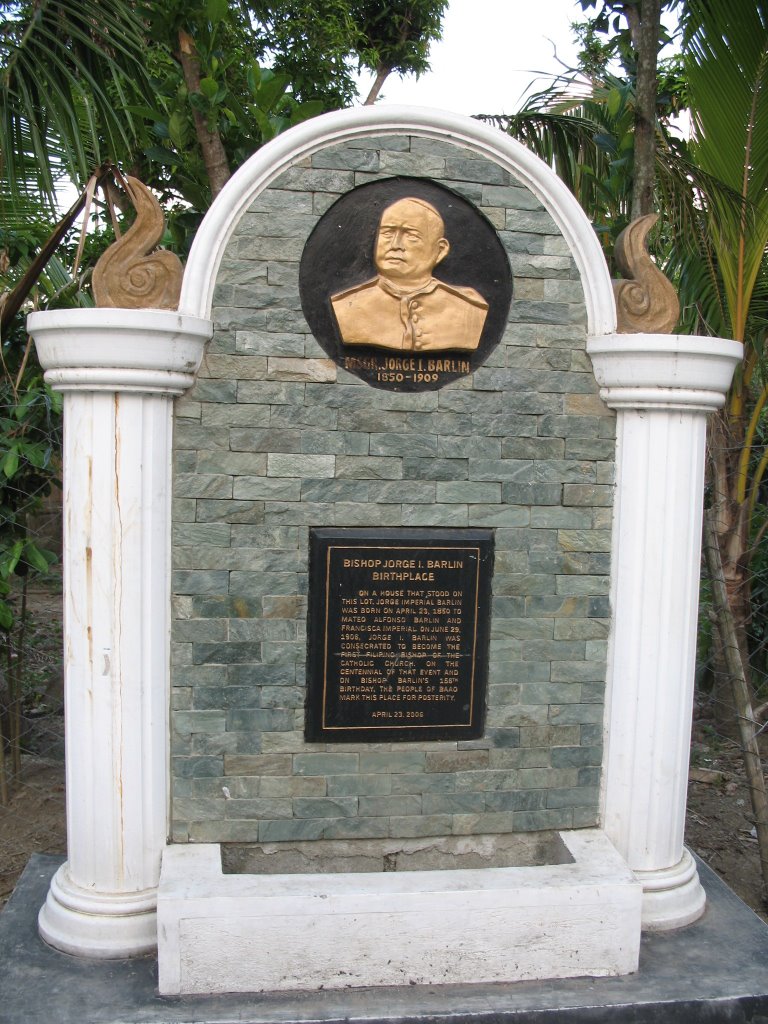
Historical Marker to Barlin's Birthplace
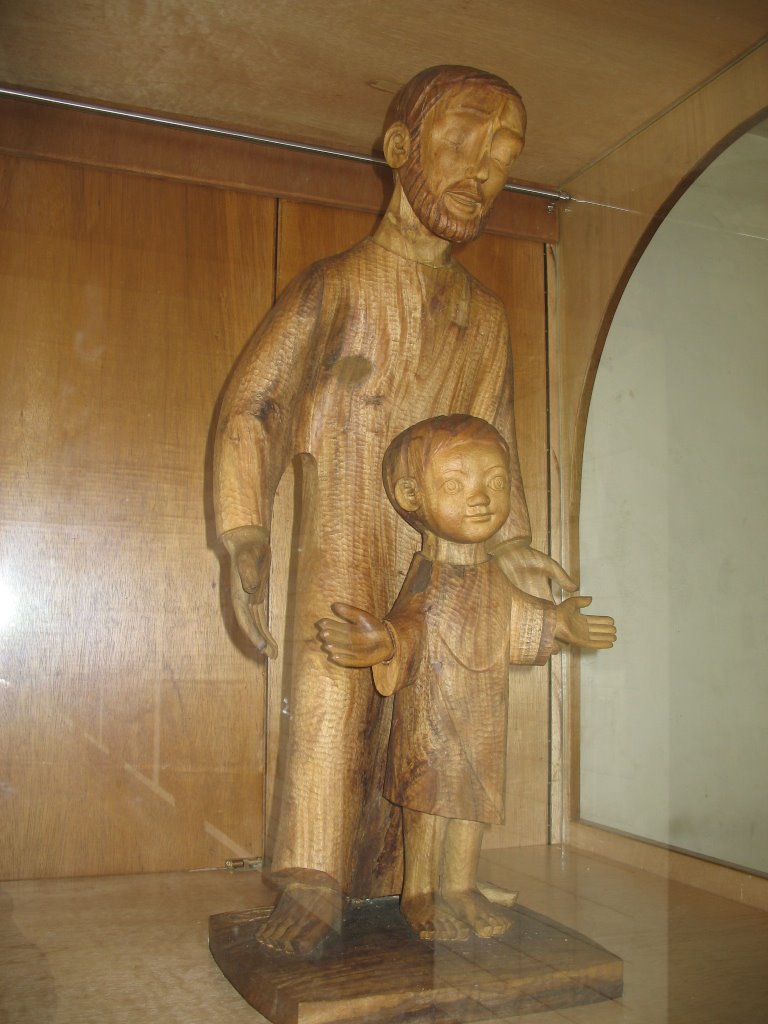
Vox Bustinera - Renown Sculptor from Baao
This wooden statue of St. Joseph by Vox Bustinera, renown sculptor from Baao, now graces the corridor of Loyola School of Theology. Von's famous wood carvings of the Stations of the Cross are also displayed at the Church of the Gesu of the Ateneo de Manila University. [Click here for more photos]
Subscribe to:
Posts (Atom)


